Shangri-La is a city in northwest Yunnan, in the Diqing Tibetan Autonomous Prefecture, where Yunnan meets Sichuan and Tibet, in the heart of the Three Parallel Rivers World Heritage area. It was called Zhongdian until 2001, when the county took the name Shangri-La, after the paradise in James Hilton’s 1933 novel Lost Horizon. Several places claimed the name, and the Yunnan government began the renaming process in July 2001. The Ministry of Civil Affairs approved it on 17 December 2001, and the county became a city in 2014.
| City | 11,418 km²; 186,400 residents (2020); formerly Zhongdian; renamed Shangri-La in 2001 |
|---|---|
| Diqing Prefecture | 23,186 km²; about 387,500 residents; Tibetans about 33%, Lisu about 27%; heart of the Three Parallel Rivers site |
| Songzanlin Monastery | built 1683; 3,380 m; largest Tibetan Buddhist monastery in Yunnan; destroyed 1966, rebuilt from 1982 |
| Pudacuo National Park | opened 1 August 2006; first protected area in China called a national park; 5A since November 2012 |
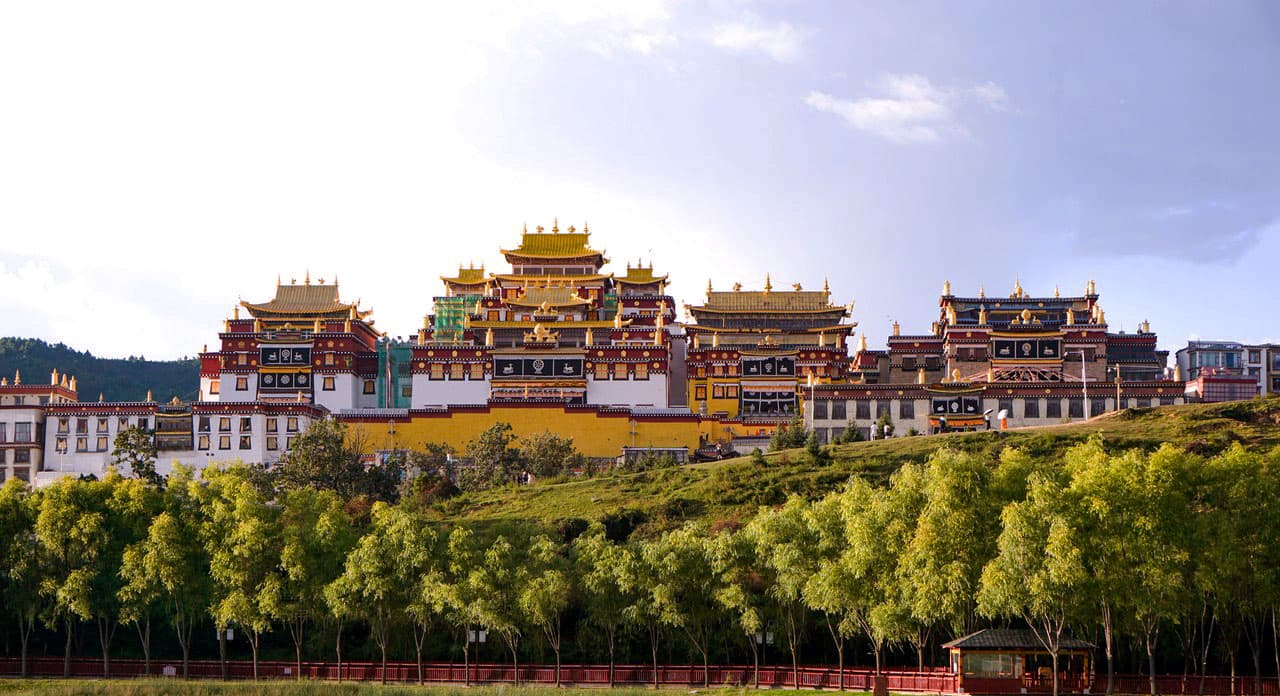
Songzanlin Monastery
The monastery, called Ganden Sumtsenling in Tibetan and nicknamed the Little Potala, stands about five kilometers north of the town at 3,380 meters and is the largest Tibetan Buddhist monastery in Yunnan. It belongs to the Gelug school. The Fifth Dalai Lama chose the site and named it, and it was built in 1683 with the approval of the Kangxi emperor on the ruins of an older Karma Kagyu monastery. In 1724 the Qing court renamed it Guihua Temple. By the 18th century it had more than a thousand monks, and in the Qianlong reign their number was fixed at 1,226. The original buildings were destroyed in 1966 during the Cultural Revolution, and rebuilding on the ruins began in 1982.
Pudacuo National Park
Pudacuo is named after Bita Lake and takes in lakes, wetlands, forest, meadows and glacier remains. The park was set up by Yunnan’s forestry department in 2006 and opened on 1 August 2006, and it was formally inaugurated on 21 June 2007. It was rated 5A in November 2012. In 2016 it became a national park pilot of 602.1 square kilometers covering three townships and 43 natural villages, with more than 6,600 residents. The Bita Lake and Shudu Lake areas are the main visitor routes. Check what is open when you go, since access can change.
The Shangri-La name and the region
Several places have claimed to be the real Shangri-La. The explorers Alexandra David-Néel and Joseph Rock are cited in these claims, which began in the 1990s, and Daocheng in Sichuan also renamed a township Shangri-La in 2002. The prefecture is also historically a stop on the Tea Horse Road. For the route south, see Tiger Leaping Gorge and Lijiang.
Planning Shangri-La
The town sits at high altitude, so allow a day to adjust before hiking. Two nights covers the monastery, the old town and Pudacuo. Nights are cold at any time of year. Most travelers come from Lijiang or Dali by road; see our Dali page and China tours.
Planning Shangri-La with Absolute Asia Tours
Absolute Asia Tours has planned private trips in Asia since 1989. For Shangri-La that means a gradual climb from Lijiang, a guide who explains the monastery, and a warm hotel. We’re rated 4.8 out of 5 across about 900 traveler reviews. See our China tours or tell us your dates.
Sources (read in Chinese, Chinese Wikipedia): 香格里拉市, 松赞林寺, 普达措国家公园, 迪庆藏族自治州. Last checked November 2026.
Shangri-La: FAQ
Why is it called Shangri-La?
The county, formerly Zhongdian, was renamed in December 2001 after the paradise in James Hilton’s 1933 novel Lost Horizon.
What is Songzanlin Monastery?
The largest Tibetan Buddhist monastery in Yunnan, a Gelug monastery built in 1683 and rebuilt after 1966.
What is Pudacuo National Park?
A national park of lakes, wetlands and meadows near Shangri-La that opened on 1 August 2006.
How high is Songzanlin Monastery?
About 3,380 meters above sea level.
How many days do you need in Shangri-La?
Two nights, with a day to adjust to the altitude.