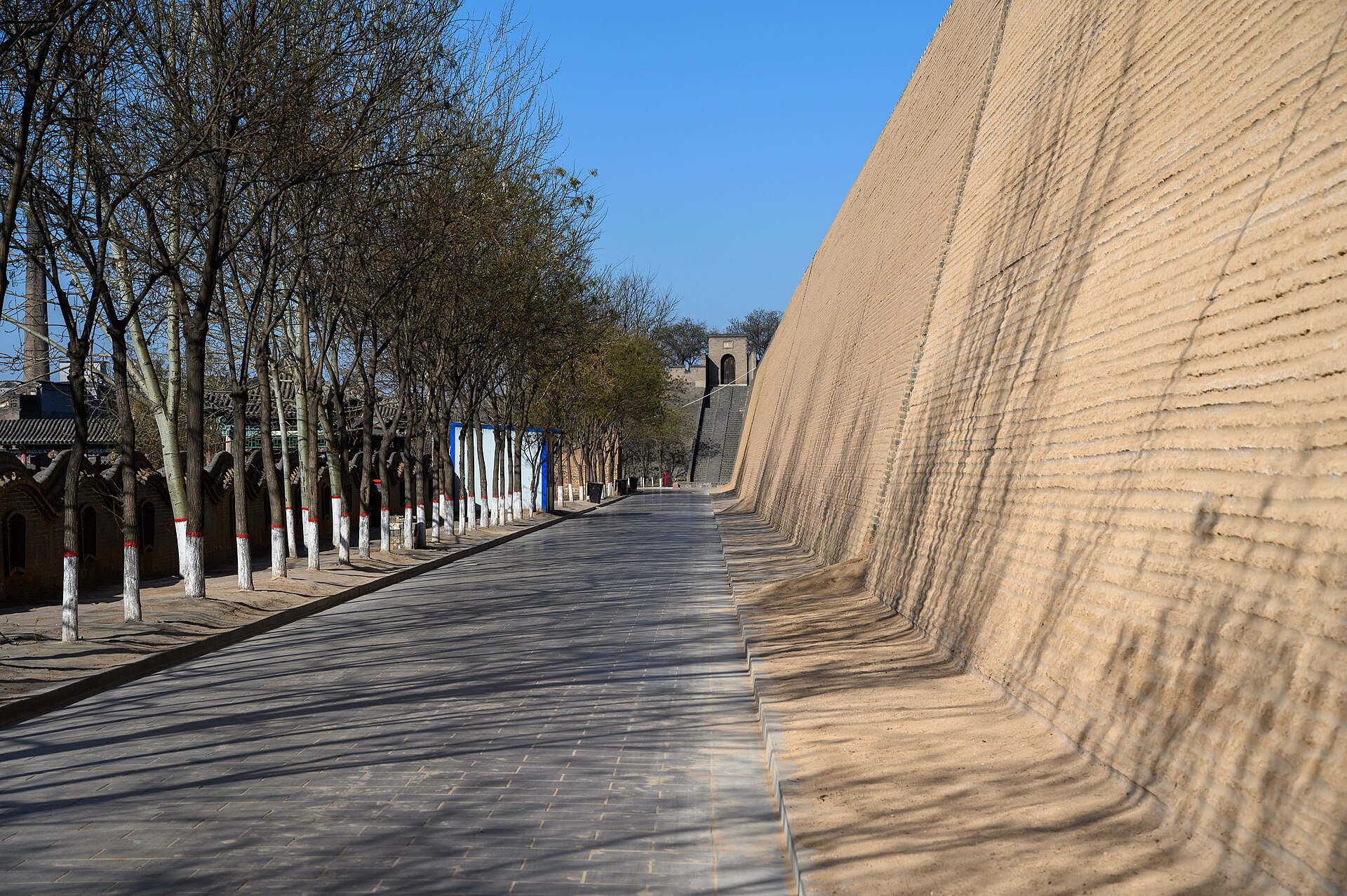
Pingyao is a walled town in central Shanxi that looks much as it did in the Ming and Qing dynasties. In the 19th century it was also the banking capital of China, and the merchants’ courtyard houses and bank offices are part of what makes it different from other old towns in the country. It’s easy to add to a route between Xi’an and Beijing.
| City wall | built 1370, about 225 ha enclosed |
|---|---|
| Watchtowers | 72 on the wall, 6 gate barbicans |
| UNESCO | 1997 |
| Draft banks | more than 20 headquartered here in the late Qing |
| Rishengchang | first of the draft banks |
The city walls
The surviving city was built in 1370, in the reign of the first Ming emperor, on a site that’s been settled for nearly 2,800 years. The walls enclose about 225 hectares and have six gates, and from above the plan resembles a turtle, with the south and north gates as the head and tail. The walls have four corner towers, 72 watchtowers and about 3,000 crenellations. A section by the south gate collapsed in 2004, and the rest is largely intact. Walk the top of the wall for an overview, then drop down into the lanes.
The old banking capital
By the late Qing dynasty more than 20 draft banks, known as piaohao, had their headquarters in Pingyao, over half of those in the country. It earned the name “the Wall Street of ancient China.” The largest and first was Rishengchang, which grew out of a dye shop on West Street. Its merchants moved money by drafts rather than carrying silver on the road, and the bank’s slogan was about remitting money all over the country. The former Rishengchang headquarters is open as a museum and shows how the system worked.
Houses and temples
There are 3,798 old dwellings in and around the city, with 1,075 registered cultural relics, 20 of them of national rank. In 1997 UNESCO listed the ancient city together with two temples outside the walls, Shuanglin Temple, known for its painted clay sculptures, and Zhenguo Temple. Pingyao also hosts an international film festival, which brings crowds, so check the dates before you book.
When to go and how long to stay
Spring and autumn are comfortable, and winters are cold and dry. One night inside the walls is worth it, because the day-trippers leave and the lanes are quiet in the evening. See our guides to Xi’an and Beijing, and our China tours.
Planning Pingyao with Absolute Asia Tours
Absolute Asia Tours has planned private trips in Asia since 1989. In Pingyao that means a guide who can explain the banking history, a stay in a restored courtyard house, and a route from Xi’an or Beijing that doesn’t rush it. We’re rated 4.8 out of 5 across about 900 traveler reviews. Tell us your dates and we’ll plan from there.
Sources (read in Chinese, Chinese Wikipedia): 平遥古城, 平遥古城, 日昇昌. Last checked November 2026.
Pingyao: FAQ
When were Pingyao’s walls built?
The surviving walls date from 1370, in the early Ming dynasty.
Why is Pingyao called the Wall Street of ancient China?
In the late Qing dynasty more than 20 draft banks had their headquarters there, over half of all in the country.
What is Rishengchang?
The first and largest of the draft banks, now a museum.
Is Pingyao a World Heritage Site?
Yes, UNESCO listed the ancient city in 1997 with two nearby temples.
How long do you need in Pingyao?
One night is ideal, two if you add the temples.
Why is it shaped like a turtle?
The six gates form the head, tail and four legs of the shape, which is why it’s nicknamed the Turtle City.
Photo: xiquinhosilva, Wikimedia Commons, CC BY 2.0.
