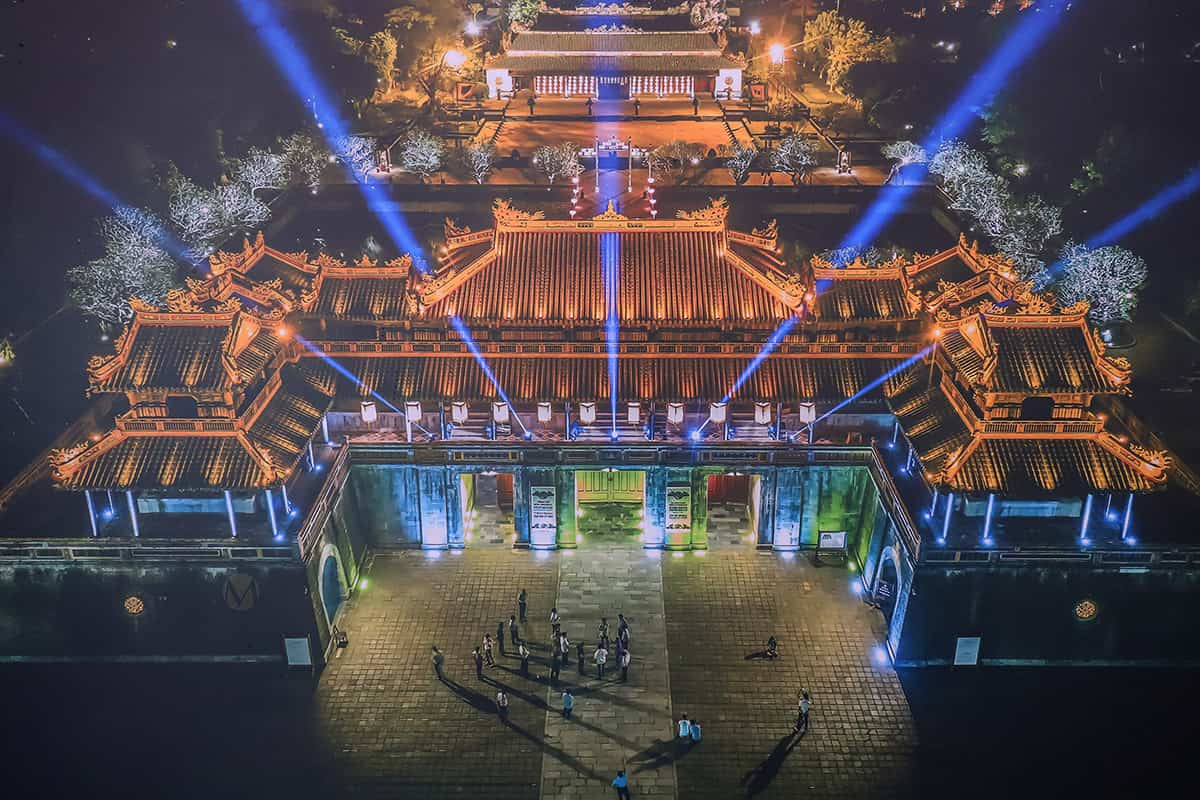
| Imperial Citadel | surveyed from 1803 under Gia Long; building began in 1805 and was finished in 1832 under Minh Mang |
|---|---|
| Flag Tower | built 1807, repaired 1829, 1831 and 1840 |
| Quoc Tu Giam | Gia Long set up the first Nguyen school in 1803; moved inside the citadel in 1908 |
| Capital until | 1945, when the last Nguyen emperor Bao Dai abdicated |
Vietnam – Getting to know Hue
Hue was Vietnam’s capital until 1945, when Bao Dai, the last of the Nguyen emperors, abdicated from the throne. Many of Hue’s attractions are historic, and found along the banks of the Perfume River, which flows through the centre of the city. The Imperial Citadel is unquestionably the central highlight and cannot be missed as you pass through the city centre or along the Perfume River; however travellers that give the city a full day will discover many more highlights. Other highlights include the Thien Mu Pagoda and the elaborate mausoleums of Emperors Tu Duc and Khai Dinh.
With its very central location close to the former DMZ. Hue suffered greatly during the American-Vietnamese war when the north invaded the American occupied south and today there is much evidence of this. If you have the time we suggest a visit to the DMZ region, the Highway of No Joy near Quang Tri, as well as the Vinh Moc Tunnels. They can all be visited as a day trip from the city.
What to do in Hue
On the north bank of the river is the Imperial Citadel, built in a similar style to Peking’s Forbidden City, enclosed by 10-metre thick walls and surrounded by a moat.
Further up the river is perhaps Hue’s best-known religious site, Thien Mu Pagoda, with its distinctive seven-storey octagonal tower.
The elaborate mausoleums of the Nguyen emperors, more like palaces than tombs, are scattered around the countryside on the outskirts of Hue. The mausoleums of Vietnam Emperors Tu Duc, Khai Dinh are particularly impressive being extravagant complexes of pavilions, temples, courtyards and lakes.
How long in Hue?
A full day, or ideally a day and half, will be sufficient time for most visitors, often eager to head further south to charming Hoi An.
The Imperial Citadel
Gia Long had the site surveyed in 1803, construction began in 1805, and it was completed in 1832 under Minh Mang. The Flag Tower, on the south face, was built in 1807 and repaired in 1829, 1831 and 1840. The Quoc Tu Giam, the Nguyen dynasty’s national school, was first built by Gia Long in 1803 about 5 kilometers west of the citadel, beside the Temple of Literature and facing the Perfume River, and was moved inside the citadel area in 1908. Check opening hours and ticket rules with the Hue monuments conservation center before you go.
Sources (read in Vietnamese, Vietnamese Wikipedia): Quần thể di tích Cố đô Huế. Last checked November 2026.
Hue: FAQ
When was the Hue Imperial Citadel built?
From 1805 to 1832, begun by Gia Long and completed under Minh Mang.
When was Hue the capital?
Until 1945, when Bao Dai, the last Nguyen emperor, abdicated.
What is the Flag Tower in Hue?
A tower on the south face of the citadel, built in 1807 and repaired several times.
Where is the Quoc Tu Giam in Hue?
It was first built about 5 kilometers west of the citadel in 1803 and moved into the citadel area in 1908.
How long do you need in Hue?
A full day covers the citadel and a few mausoleums.