Busan is South Korea’s second-largest city and its biggest port, a long strip of beaches, hills and harbor at the country’s southeast corner. It feels more relaxed than Seoul, and the sights are a mix of the seaside, the street art and the food. It’s an easy add-on to a Seoul trip, and it works as a stopover on the way to Jeju.
| Treaty port | opened 1876 |
|---|---|
| Haeundae Beach | about 1.5 km long, swimming season early June to end of September |
| Gwangalli Beach | about 1.4 km long |
| Gamcheon | settled in the 1950s, mural project from 2009 |
| Rank | South Korea’s second-largest city and largest port |
A port city
Busan opened as a treaty port in 1876, one of the first three in Korea, along with Incheon and Wonsan. During the Korean War it was the country’s temporary capital and a refuge for people from across the peninsula, and that history shapes the city today. It hosted the 2002 Asian Games and the 2005 APEC summit, and it’s home to the Busan International Film Festival.
Haeundae and Gwangalli beaches
Haeundae is the best-known beach in Korea. It’s about 1.5 kilometers long and 30 to 50 meters wide, with hundreds of hotels and restaurants behind it, and its swimming season officially runs from early June to the end of September. Dongbaek Island, a short walk along the shore from the beach, has a path through camellia trees and the Nurimaru, the building that hosted the 2005 APEC summit.
Gwangalli is a smaller, quieter beach to the southwest, about 1.4 kilometers long, with cafes along the promenade and a view of the Gwangan Bridge, which is lit with colored LEDs after dark. The Busan fireworks festival is held here and draws crowds of more than a million.
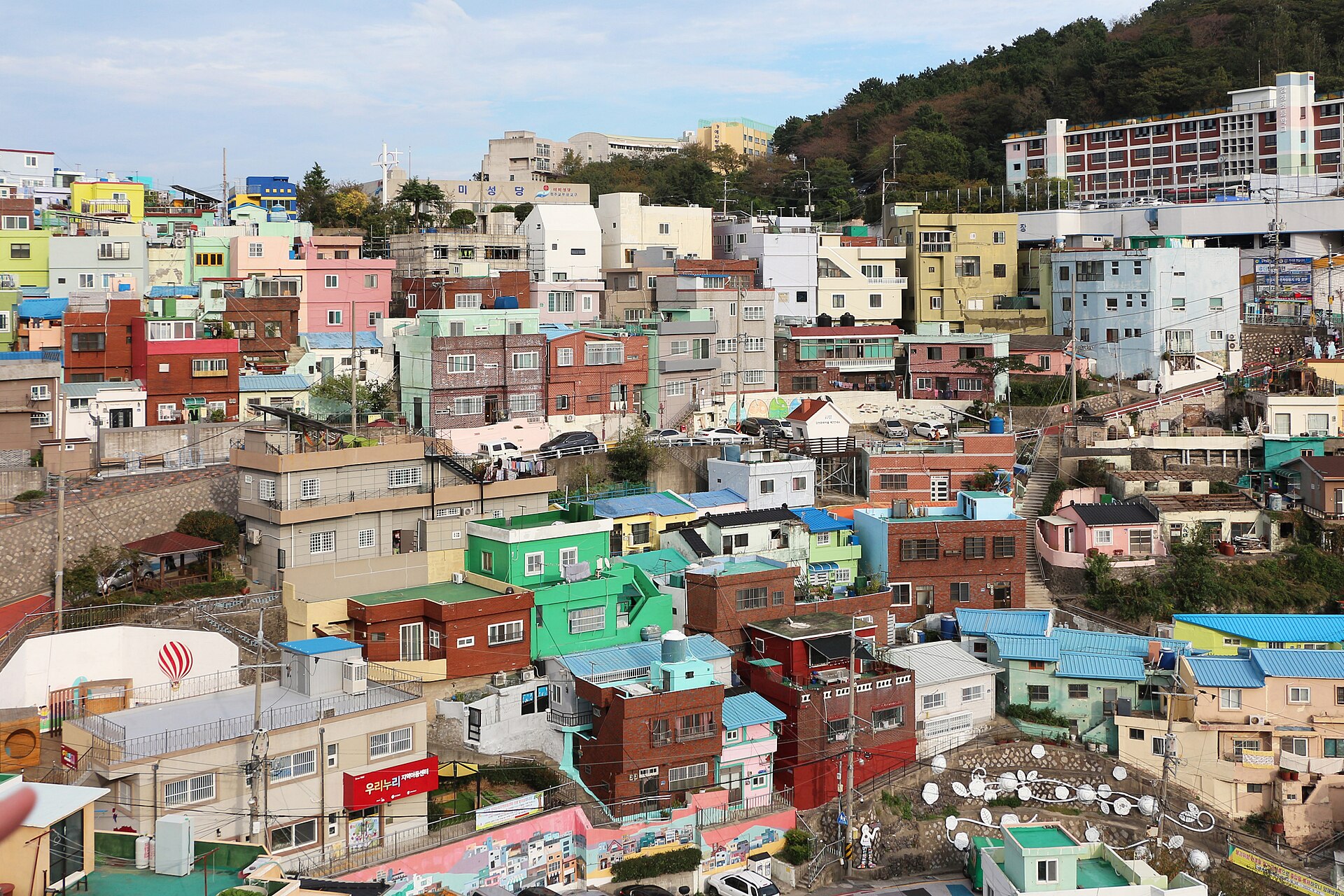
Gamcheon Culture Village
On a steep hillside in the Saha district, Gamcheon was settled in the 1950s by followers of the Taegukdo religion and by Korean War refugees. In 2009 local artists and residents began painting murals on walls and houses as part of a regeneration project, and the village was designated a culture village in 2010. It’s now one of the most photographed places in the city. Residents still live here, so keep to the marked routes and keep your voice down.
Jagalchi Market
Jagalchi is Korea’s best-known fish market, beside Nam Port in the old city center. The market area stretches from the dried-fish stalls near Yeongdo Bridge to the early-morning market in Chungmu-dong. Go in the morning to watch the trade, then eat at one of the restaurants upstairs or nearby, where you can choose live seafood and have it prepared.
Haedong Yonggungsa
Few Korean temples sit directly on the sea. Haedong Yonggungsa, on the coast of Gijang county, east of the city center, is one of them, with its halls built along the rocks above the waves. Its own history says it was founded in 1376, though Korean sources note that the date has been questioned. Come early on weekends, when it fills up.
What to eat
The dish most associated with Busan is dwaeji-gukbap, a pork-bone soup served with rice. It’s traced to refugees who settled in the city after the Korean War. Seafood is the other draw, especially at Jagalchi and along Gwangalli.
Getting there and how long to stay
Busan is reached from Seoul by high-speed train or by air, and it has an international airport and ferry links with Japan. Two nights cover the beaches, Gamcheon, Jagalchi and the temple. See our guides to Seoul and Jeju Island, and our South Korea tour packages. For the season, see South Korea in winter and autumn in South Korea.
Planning Busan with Absolute Asia Tours
Absolute Asia Tours has planned private trips in Asia since 1989. For Busan that means a private guide for Gamcheon and the market, a driver for the temple on the coast, and a hotel on the right beach for the season. We’re rated 4.8 out of 5 across about 900 traveler reviews. Have a look at our South Korea tours or tell us your dates.
Sources (read in Korean, Korean Wikipedia): 부산광역시, 감천문화마을, 해운대해수욕장, 자갈치시장, 해동용궁사. Last checked November 2026.
Busan: FAQ
How many days do you need in Busan?
Two nights cover the beaches, Gamcheon, Jagalchi and the seaside temple.
What is Busan known for?
Beaches, a port and a fish market, the colorful Gamcheon hillside village, and the film festival.
When is the swimming season at Haeundae?
The official season runs from early June to the end of September.
What is Gamcheon Culture Village?
A hillside neighborhood settled by refugees and followers of the Taegukdo faith in the 1950s, turned into an art village from 2009.
What is dwaeji-gukbap?
A pork-bone soup served with rice, associated with Busan since the Korean War.
How do you get from Seoul to Busan?
By high-speed train or a short flight.
Photo: Bernard Gagnon, Wikimedia Commons, CC0.
