Gyeongju was the capital of the Silla kingdom for nearly a thousand years, from 57 BC to AD 935, and the city still looks like it: grassy burial mounds the size of hills sit between modern streets, and temples, pavilions and royal ponds are scattered across the plain and the mountains around it. It’s often described as a museum without walls. It’s the best place in South Korea to see the country’s ancient past, and an easy trip from Seoul or Busan.
| Silla capital | 57 BC to AD 935 |
|---|---|
| Historic Areas | UNESCO, December 2000 |
| Bulguksa and Seokguram | UNESCO, 1995 |
| Cheomseongdae | 9.4 m, 27 tiers, National Treasure No. 31 |
| Wolji Pond | dug 674, renamed from Anapji in 2011 |
The Gyeongju Historic Areas
UNESCO listed the Gyeongju Historic Areas in December 2000. They cover five districts: Wolseong (the site of the royal palace), Hwangnyongsa (a great temple site), Sanseong (a mountain fortress), Namsan (a mountain of Buddhist carvings) and Daereungwon (the royal tombs). Korean sources note that the density and variety of the remains compare well with the heritage sites of Kyoto and Nara.
Bulguksa and Seokguram
Bulguksa is a hillside temple on Mount Toham, listed by UNESCO in 1995 together with the Seokguram grotto. Temple records say it was founded in 528 and was greatly expanded in 751 by the minister Kim Daeseong, according to the Korean accounts, and its stone bridges, pagodas and terraces are among the most admired Buddhist architecture in Korea. Entry was made free from May 2023, according to Korean sources, but check the current rule and the parking fee before you go.
Seokguram sits higher on the same mountain. It’s a granite cave temple, begun in 751 and finished in 774, and Korean sources describe it as the only man-made granite grotto in the world. It holds a seated Buddha, and photography is not permitted inside. Many visitors combine Seokguram and Bulguksa in a morning.
Cheomseongdae
Cheomseongdae is a small bottle-shaped tower of 27 courses of stone, about 9.4 meters tall, built during the reign of Queen Seondeok. It was named a National Treasure in 1962 and is traditionally considered the oldest surviving astronomical observatory in Asia, although scholars still debate what it was used for. It’s only a few minutes’ walk from the tombs.
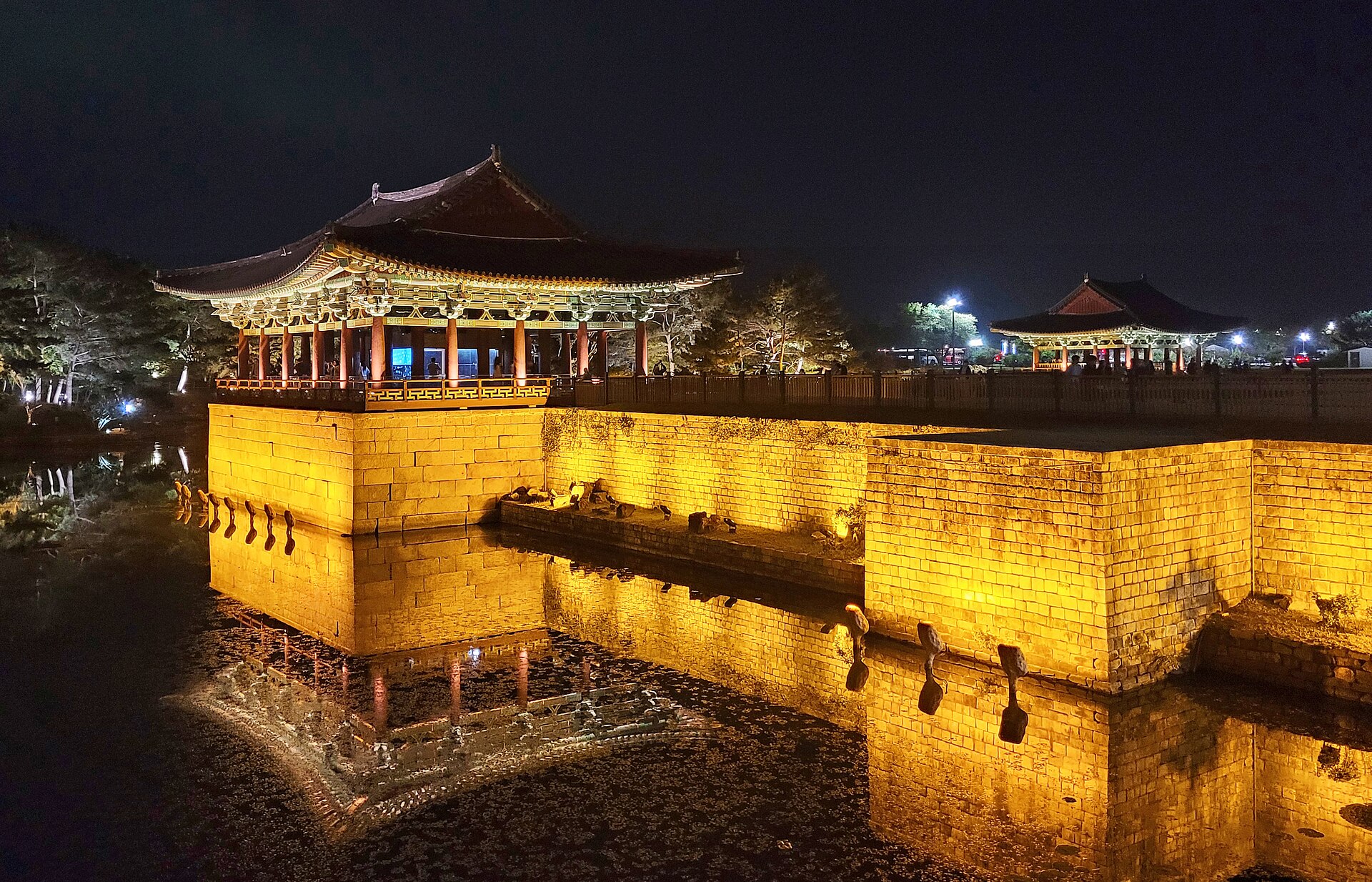
Wolji Pond at night
Donggung Palace and Wolji Pond were the prince’s palace and pleasure garden of the Silla royal court. In 674 King Munmu had a large pond dug, with three islands in it, and the court held banquets here. After Silla fell in 935 the pond was neglected, and in the Joseon era visitors named it Anapji, “the pond of geese and ducks.” Excavations in 1980 showed that its Silla name was Wolji, and it was officially renamed in 2011. The pavilions are lit at night and reflected in the water, and it’s the single best reason to stay overnight in Gyeongju.
The royal tombs at Daereungwon
In the middle of town, Daereungwon is a park of grass-covered royal tombs, some very large. The gold crown found at Geumgwanchong, a tomb in the Noseo-dong group, was discovered in 1921, and finds from the tombs are displayed at the National Museum in Gyeongju. Walk through the park to see how large the mounds are up close.
Getting there and how long to stay
Gyeongju is reached by high-speed train and then a local bus or taxi, or by road from Busan, which is the nearest large city. Stay two nights if you can: one day for Bulguksa and Seokguram, and one for the tombs, the pond and Namsan. See our guides to Busan and Seoul, South Korea tour packages, and our guides to autumn in South Korea and winter in South Korea.
Planning Gyeongju with Absolute Asia Tours
Absolute Asia Tours has planned private trips in Asia since 1989. For Gyeongju that means a private guide who can read the Silla story into the mounds and ruins, a driver between the temple, the tombs and the pond, and a hotel close to Wolji for the evening. We’re rated 4.8 out of 5 across about 900 traveler reviews. Have a look at our South Korea tours or tell us your dates.
Sources (read in Korean, Korean Wikipedia): 경주시, 불국사, 석굴암, 첨성대, 동궁과 월지. Last checked November 2026.
Gyeongju: FAQ
What is Gyeongju known for?
It was the capital of the Silla kingdom, and it has two UNESCO World Heritage Sites: the Historic Areas and the Bulguksa and Seokguram sites.
How many days do you need in Gyeongju?
Two days. One for Bulguksa and Seokguram, one for the tombs, Cheomseongdae, Wolji and Namsan.
How do you get to Gyeongju from Seoul?
By high-speed train to the Gyeongju area, then a bus or taxi into town.
Can you take photos inside Seokguram?
No. Photography is not allowed inside the grotto.
What is Cheomseongdae?
A 9.4-meter stone tower from the Silla period, traditionally considered Asia’s oldest surviving observatory.
What is the best time to visit Gyeongju?
Spring and autumn, but the city is also quieter in winter. Check the evening lighting hours at Wolji before you plan around them.
Photo: Bernard Gagnon, Wikimedia Commons, CC0.
