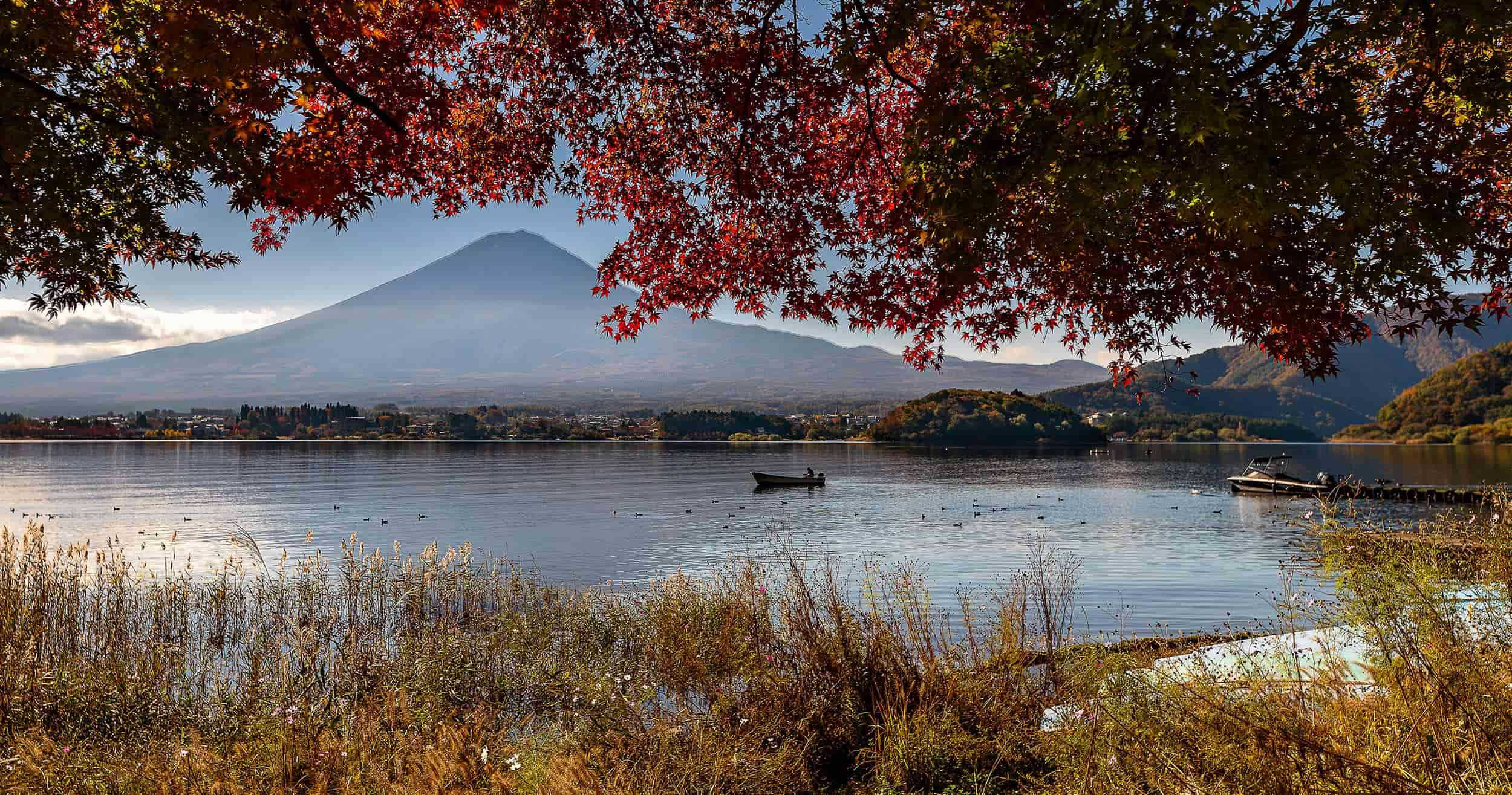
Mount Fuji is the first thing many travelers think of when they picture Japan, and the first question they ask is practical: where exactly is it, and can I climb it? The short answers are that it sits southwest of Tokyo, straddling two prefectures, and that you can climb it for only about two months a year.
| Height | 3,776 m |
|---|---|
| Location | border of Yamanashi and Shizuoka |
| UNESCO | cultural site, 2013 |
| Trails | Yoshida, Subashiri, Gotemba, Fujinomiya |
| Climbing season | early July to early September (2026: 10 July to 10 September) |
| 2026 entry rule | no entry 2 PM to 3 AM except for hut guests |
Where is Mount Fuji?
Mount Fuji sits on the border of Yamanashi and Shizuoka prefectures, southwest of Tokyo on Honshu, Japan’s main island. It’s an active volcano and Japan’s highest peak, 3,776 meters at its highest point, and its near-perfect cone is visible on clear days from Tokyo and from the Shinkansen, especially in winter when the air is dry. In 2013 UNESCO listed it as a World Heritage Site. The listing is a cultural one, for the mountain’s role as a sacred place and a source of artistic inspiration, not a natural one.
Can you climb Mount Fuji?
Yes, but only in the official climbing season, which runs from early July to early September. Outside the season, the trails are closed and the official climbing website warns that climbing is dangerous: the mountain huts and first-aid stations are shut, there is no mobile phone service, and the weather is severe. The exact dates are announced before each season. In 2026 the routes above the 6th station on the Fujinomiya side were open from 10 July to 10 September.
The four trails
Four trails lead to the summit: Yoshida, Subashiri, Gotemba and Fujinomiya. All start from a “5th station” partway up the mountain, but they differ in length, crowds and the number of huts. From the 5th station to the summit, the climb is more than 1,000 meters of elevation, and the official site stresses that it is not a mountain everyone can easily climb.
Rules to know for 2026
- Entry hours. Entry onto the mountain is not permitted from 2 PM to 3 AM the next day, unless you have a booking at a mountain hut.
- Hiking fee. A fee of 4,000 yen applied in the 2026 season, paid through the official system.
- Registration. Entry registration and reservations are made through a web system. This is separate from booking a hut.
- Cold. The temperature drops about 0.6 °C for every 100 meters you climb, and it can fall close to freezing at the summit before sunrise, even in summer.
- Gear. The official list includes hiking boots, rain gear, warm clothing, a headlamp with spare batteries, water and snacks, and plenty of cash and 100-yen coins for huts and toilets.
The rules, fees and dates can change from year to year, so check the official Mt. Fuji climbing website before you book. Mountain huts fill up early.
How to get to Mount Fuji from Tokyo
Most visitors go to the Fuji Five Lakes area on the Yamanashi side, around Kawaguchiko Station, and many continue to the 5th Station for the climb. Japan-guide, an independent Japan travel reference, lists these options from Tokyo. Fares and schedules change, so check them before you go.
| Route | Time | One-way fare listed |
|---|---|---|
| Bus from Shinjuku Bus Terminal | just under 2 hours | 2,200 yen (2,000 yen online) |
| Bus from Tokyo Station (Yaesu South Exit) | about 2 hours | 2,300 yen |
| Bus from Shibuya (Mark City) | 2 to 2.5 hours | 2,300 yen |
| Train via Otsuki (JR Chuo Line, then Fujikyu Railway) | 70 minutes to Otsuki plus 55 minutes | 2,430 yen by limited express plus 1,170 yen |
| Direct limited express train | about 2 hours | 4,200 yen, reserved seats only |
The buses leave about twice an hour from Shinjuku. The Japan Rail Pass is not valid on them, and it is not valid on the Fujikyu line between Otsuki and Kawaguchiko either. Once there, the Omni buses from Kawaguchiko Station are the easiest way around the lake, and a bus runs from the station to the Fuji Subaru Line 5th Station halfway up the mountain. A 1-day bus pass for the Kawaguchiko, Saiko and Motosuko area was listed at 1,500 yen.
Where to stay to climb Mount Fuji
You have two choices. A mountain hut on the trail is the way to climb overnight, and the official climbing site says hut bookings are separate from your mountain entry registration. The alternative is a hotel or guesthouse at the base, in the Fuji Five Lakes towns around Kawaguchiko or on the Shizuoka side, and to climb in a single push, which the official site treats with caution because of the cold and the 2 PM to 3 AM entry restriction. Book early in the season, because huts fill up.
Seeing Mount Fuji without climbing it
Most visitors don’t climb it, and you don’t need to. The Fuji Five Lakes area on the Yamanashi side and the Hakone region to the east are the usual bases, and the mountain can be viewed from lakeshores, ropeways and trains on a clear day. Fuji is often hidden in cloud, so the best chance of a clear view is early in the morning, and in autumn and winter. A multi-day trip gives you more chances than a single day. See our guide to Hakone, plus our guides to fall foliage and Japan in winter.
Getting there
Fuji is within a day trip of Tokyo, though a night near the mountain gives you better chances at a clear view. Trains and buses serve the lakes and the 5th stations. Access to the 5th stations changes in the climbing season, and private vehicles are restricted on some roads, so check before you go. See our Tokyo private tour guide and our Japan tour packages for routes that include Fuji.
Planning Mount Fuji with Absolute Asia Tours
Absolute Asia Tours has planned private trips in Asia since 1989. For Fuji that means a base chosen for the view and a weather-flexible schedule, a private driver for the road to the 5th station, and, if you want to climb, hut bookings and registration handled in the right season. We’re rated 4.8 out of 5 across about 900 traveler reviews. Have a look at our Japan tours or tell us your dates.
Sources (read in Japanese, Japanese Wikipedia): 富士山, 富士五湖, and the official Mt. Fuji climbing website. Transport: japan-guide, Getting to Fuji Five Lakes. Last checked November 2026.
Mount Fuji: FAQ
How do you get to Mount Fuji from Tokyo?
Usually by bus or train to Kawaguchiko Station in the Fuji Five Lakes area. A bus from Shinjuku takes just under two hours, according to japan-guide.
How much is the bus from Tokyo to Kawaguchiko?
Japan-guide lists 2,200 yen one way from Shinjuku (2,000 yen if bought online). Fares change, so check before you go.
Where should you stay to climb Mount Fuji?
In a mountain hut on the trail for an overnight climb, or in a base town such as Kawaguchiko. Huts are booked separately from the mountain entry registration.
Where is Mount Fuji in Japan?
On the border of Yamanashi and Shizuoka prefectures, southwest of Tokyo.
How tall is Mount Fuji?
3,776 meters at the highest point of the mountain. The official triangulation point on the summit is 3,775.56 meters.
When can you climb Mount Fuji?
From early July to early September. In 2026 the Fujinomiya routes above the 6th station were open from 10 July to 10 September.
Is there a fee to climb Mount Fuji?
Yes. A hiking fee of 4,000 yen applied in 2026. Check the official site for the current amount.
Can you climb Mount Fuji in winter?
The trails are closed in winter and the official site calls climbing outside the season dangerous.
Is Mount Fuji a natural or cultural World Heritage Site?
Cultural. UNESCO listed it in 2013 as a sacred place and source of artistic inspiration.