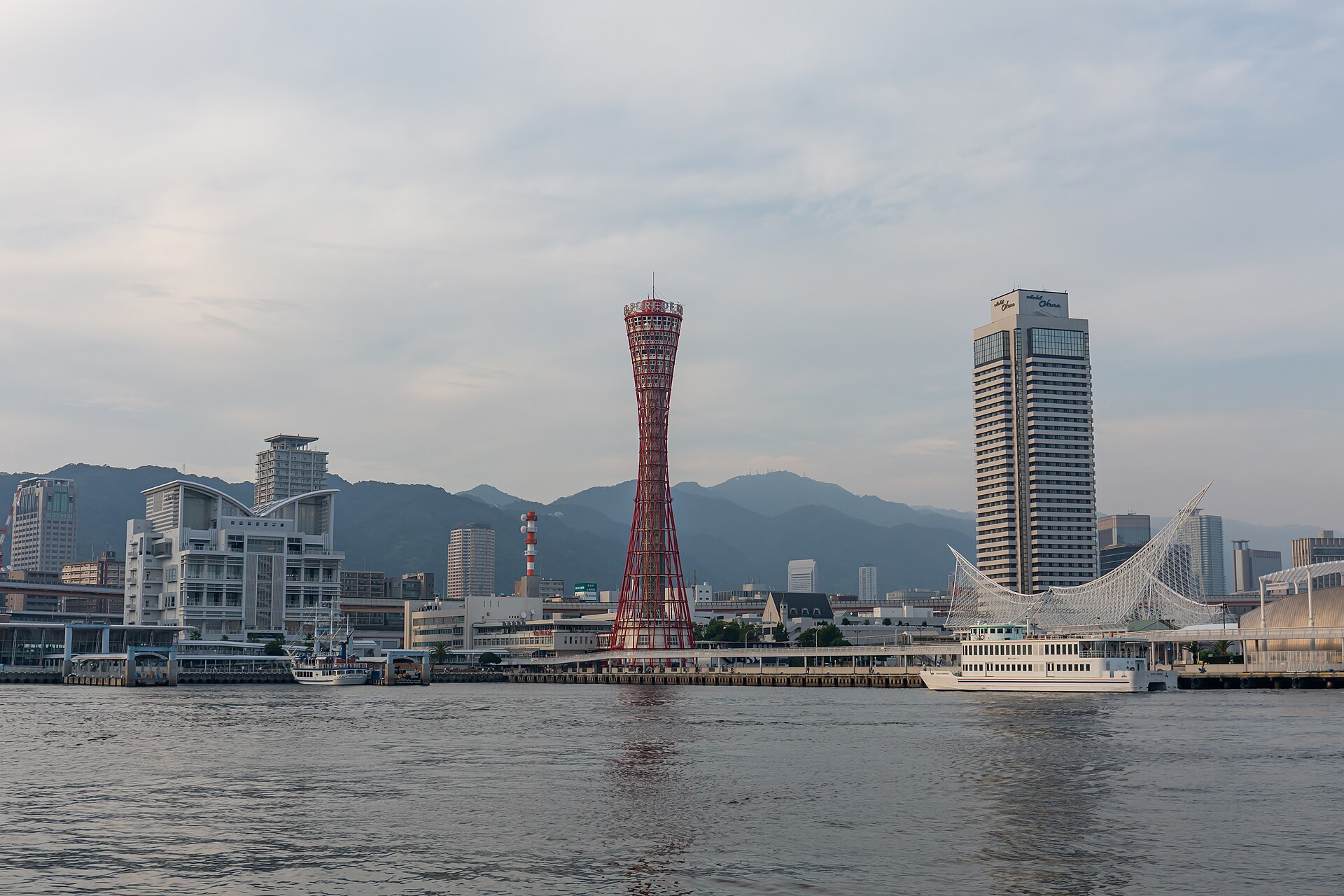
Kobe is a harbor city squeezed between the sea and a mountain ridge, and it feels different from nearby Osaka and Kyoto. It was one of the first Japanese ports opened to foreign trade, and that shows in its architecture, its food and its easy, outward-looking mood. The sights are close together, and there’s a hot spring town on the far side of the mountain.
| Port opened | 1 January 1868 |
|---|---|
| Port Tower | opened 1963, reopened 26 April 2024 |
| Kitano preservation district | 34 Western-style and 7 Japanese buildings, designated 1980 |
| Arima Onsen | spring sources up to 98 °C |
| Kobe beef | Tajima cattle, marbling score 6 or higher, brand name since 1983 |
The harbor and Kobe Port Tower
Kobe opened as a treaty port on 1 January 1868. The waterfront is where the city’s modern identity began, and the symbol of it is Kobe Port Tower, a red steel tower shaped like a drum on its side. It opened in 1963 and was the first tower in the world built from a lattice of steel pipes, 32 of them forming a curved, hourglass-like shape. It was barely damaged in the 1995 Hanshin-Awaji earthquake, and its lights came back on within a month as a sign of recovery. The tower closed in September 2021 for seismic work and reopened in April 2024. Mount Rokko behind the city blocks the cold northwest wind, which is one reason the harbor was so well protected.
Kitano and the foreign houses
On the hillside above the station, the Kitano district is full of Western-style houses, called ijinkan, built by foreign merchants and officials in the late 1800s and early 1900s. A preservation district of about 750 by 400 meters was designated in 1980, the first of its kind for a port town in Japan. It includes 34 Western-style buildings and 7 Japanese ones, mixed together on the same slopes. Pick two or three houses to go inside rather than all of them, and leave time to walk the lanes between them.
Arima Onsen
On the north side of the Rokko range, still within Kobe city limits, Arima is counted among Japan’s three oldest hot springs. The town sits in a valley at 350 to 500 meters, and its waters come in two kinds. The “gold” water (kinsen) is clear when it comes out of the ground, then turns reddish brown in the air because of its iron content, and it will stain a white towel. The “silver” water (ginsen) is clear. The hottest sources reach 98 °C. Two public baths, Kin no Yu and Gin no Yu, are open to day visitors, and many ryokan have their own baths. It makes a good half-day or overnight add-on to Kobe, away from the harbor.
Mount Rokko
Mount Rokko rises directly behind the city and is crossed by cable cars and ropeways. A “town on the mountain” of hotels and cultural facilities sits near the top, and the views down over Kobe and Osaka Bay are the reason most people go up. The ropeway on the far side runs down to Arima Onsen, so the two can be combined into a single loop.
Kobe beef: what the name actually means
Kobe beef is a name for beef, not a breed of cattle, and there are no cows called Kobe cattle. It’s the meat from Tajima cattle raised in Hyogo Prefecture that passes a set of standards: a heifer that has never calved or a steer, a marbling score of 6 or higher on the Japanese scale, and a carcass weight within a set range. Beef that qualifies carries a stamp in the shape of the Hyogo prefectural flower. Only a small share of Tajima beef qualifies, so the supply is limited, and the brand name itself dates only from 1983. If a restaurant says “Kobe beef,” ask to see the certificate or stamp; a good one will show you.
Getting there and how long to stay
Kobe is under an hour from Osaka and Kyoto by train, and it’s on the Shinkansen line. A day covers the harbor, Kitano and a dinner of local beef. Add a night for Arima Onsen and Mount Rokko. See our guides to Osaka, Kyoto and Nara, and our Japan tour packages for routes that include them.
Planning Kobe with Absolute Asia Tours
Absolute Asia Tours has planned private trips in Asia since 1989. In Kobe that means a private guide for Kitano and the harbor, a ryokan booked in Arima on a day when the baths aren’t crowded, and a table at a beef restaurant that serves the certified product. We’re rated 4.8 out of 5 across about 900 traveler reviews. Have a look at our Japan tours or tell us your dates.
Sources (read in Japanese, Japanese Wikipedia): 神戸市, 神戸ポートタワー, 北野町 (神戸市), 有馬温泉, 神戸ビーフ. Last checked November 2026.
What to do in Kobe: FAQ
Is Kobe worth visiting?
Yes, for the harbor, the Kitano foreign houses, Arima Onsen and the food. It’s easy to add to a Kyoto and Osaka trip.
How many days do you need in Kobe?
One day for the harbor, Kitano and dinner, or two if you add Arima Onsen and Mount Rokko.
What is Kobe beef?
Beef from Tajima cattle raised in Hyogo that meets set standards for sex, marbling and carcass weight. It’s a name for the meat, not a breed.
What is special about Arima Onsen?
It’s one of Japan’s three oldest hot springs, with iron-rich “gold” water that turns red-brown in the air and clear “silver” water.
Is Kobe Port Tower open?
It reopened on 26 April 2024 after seismic work that began in 2021. Check the opening hours before you go.
How far is Kobe from Osaka?
Under an hour by train.
Photo: Balon Greyjoy, Wikimedia Commons, CC0.
