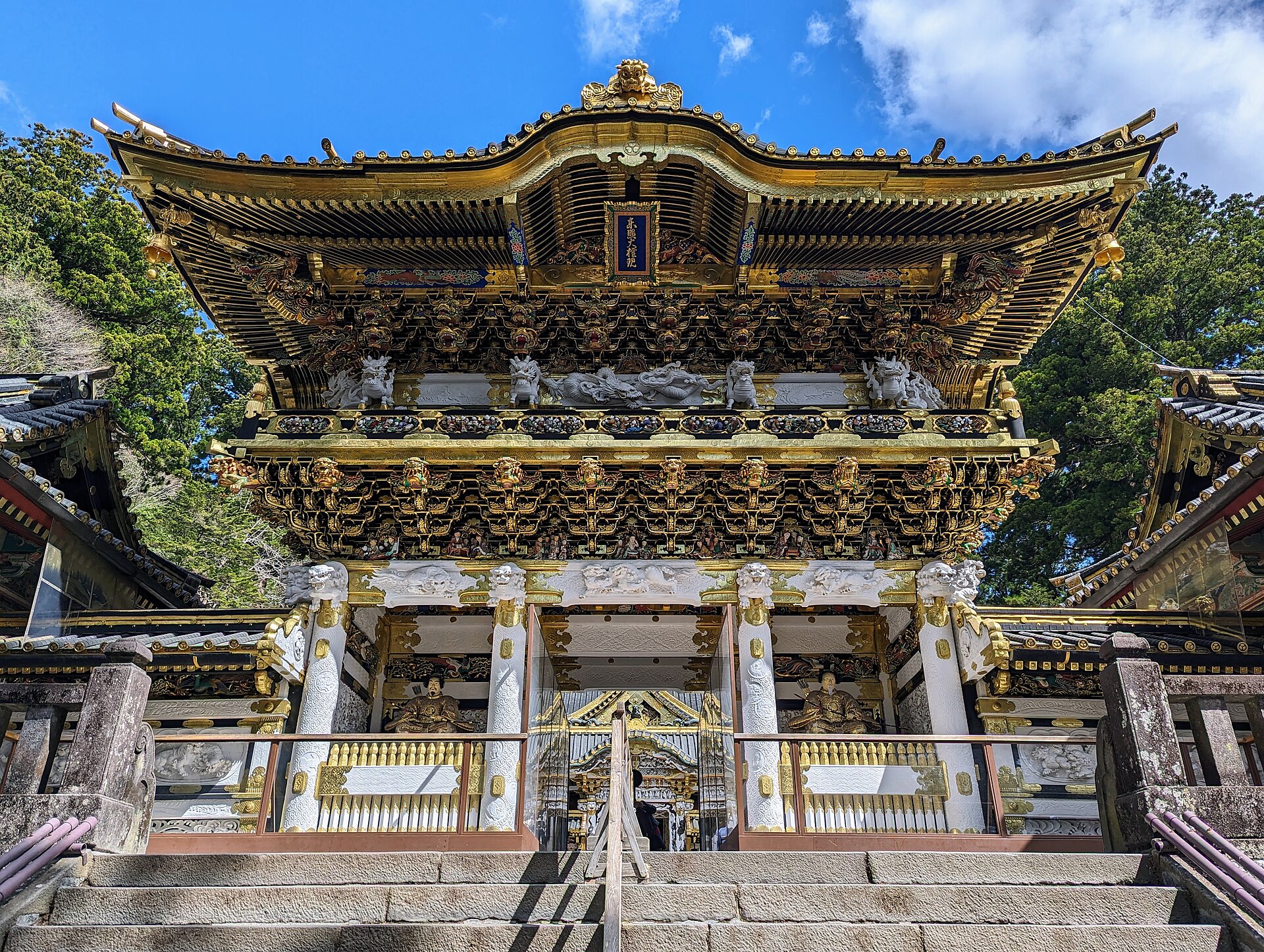
Nikko is a mountain town about two hours north of Tokyo, and it holds two of Japan’s best-known sights: a shrine so densely decorated that it was nicknamed the “all-day gate,” and a 97-meter waterfall in the mountains above it. It works as a long day trip from Tokyo, but it rewards a night if you want the lake and the trails as well.
| UNESCO | Shrines and Temples of Nikko, 1999 |
|---|---|
| Buildings | 103 (9 National Treasures, 94 Important Cultural Properties) |
| Yomeimon gate | about 11 m high |
| Kegon Falls | 97 m drop, flow regulated by a dam |
| From Tokyo | about two hours by train |
Toshogu and the shrines of Nikko
The shrine complex at Nikko is a World Heritage Site, listed by UNESCO in December 1999 as the Shrines and Temples of Nikko. It consists of three parts: the Toshogu shrine, the Futarasan shrine and the Rinno-ji temple. Together they include 103 buildings, nine of them National Treasures and 94 Important Cultural Properties, in a forested area of about 50 hectares.
Toshogu
Tokugawa Ieyasu, the founder of the shogunate, died in 1616 and was first buried in Shizuoka. In 1617 his remains were moved to Nikko, where he was enshrined as a deity. His grandson Iemitsu had the shrine rebuilt on a far grander scale in 1634 to 1636, which is the one you see today. The stone torii gate at the entrance is 9.2 meters high, the largest torii of the Edo period, and was donated by Kuroda Nagamasa in 1618; the stone for it was shipped in from Kyushu.
The star of the complex is the Yomeimon gate, about 11 meters high and covered in brightly painted carvings of dragons, lions, flowers and figures. It’s called the “gate where you can spend all day until sunset” because there is so much to look at. The gate was restored between 2013 and 2017, and some of the repainting drew public criticism, so you may find the colors brighter than in older photos. Look for the carved monkeys and the “sleeping cat” on the way through; they are among the shrine’s best-known details.
Rinno-ji and Futarasan
Rinno-ji, the Buddhist temple next door, traces Nikko’s founding as a mountain religious center to the monk Shodo in 766. Futarasan Shrine is the third site. Toshogu, Futarasan and Rinno-ji became separate institutions in the late 1860s, when Japan separated Shinto and Buddhism, which is why Nikko has two shrines and one temple. Allow half a day for the three, longer if you like to read about the buildings.
Kegon Falls
Kegon Falls drops 97 meters from the outflow of Lake Chuzenji, and is counted as one of Japan’s three great waterfalls. A paid elevator takes you down to a viewing platform close to the base of the falls, and there are other viewpoints above the gorge and from Akechidaira, which is reached by ropeway from the winding Irohazaka road.
A planning point that most guides skip: the water is released through a dam at the lake, and the flow is regulated. After a dry autumn in 2023, the lake was low, and Japanese sources report that daytime releases were cut sharply from January 2024, leaving the main fall thin enough that the rock face showed behind it. Check current conditions with the local tourist office before you plan around the falls.
Lake Chuzenji
Above the falls, Lake Chuzenji sits high in the mountains in Nikko National Park. It was formed about 20,000 years ago when an eruption of Mount Nantai dammed a valley, and it’s the highest natural lake in Japan. It’s about 25 kilometers around, a walk of roughly nine hours, so most visitors see it from a boat or a road. The Hachojidejima peninsula on the south shore is known for autumn color. The English traveler Isabella Bird visited in 1878 and wrote admiringly of Mount Nantai reflected in the lake as she looked down from the top of the climb.
When to go
Autumn is the busiest season, when the leaves turn first around the lake and later in the town. The mountains are much cooler than Tokyo at any time of year, so bring a layer even in summer. In winter the high ground is cold and snowy, and some roads and facilities change their schedules, so check before you go. See our guide to fall foliage in Japan and our guide to Japan in winter.
Getting there
Nikko is about two hours from Tokyo by train. Two stations serve the town, Tobu-Nikko on the Tobu line and JR Nikko, and a gate street runs between them toward the shrines. Buses and taxis cover the longer run up to Kegon Falls and the lake. See our Tokyo private tour guide for what to combine with a day in the mountains, and our Japan tour packages for sample routes.
Planning Nikko with Absolute Asia Tours
Absolute Asia Tours has planned private trips in Asia since 1989. For Nikko that means a private guide who can explain the symbols in the carvings and why the shrine was built here, a driver for the climb to the falls and the lake, and a start early enough to see Toshogu before the tour groups arrive. We’re rated 4.8 out of 5 across about 900 traveler reviews. Have a look at our Japan tours or tell us your dates.
Sources (read in Japanese, Japanese Wikipedia): 日光市, 日光東照宮, 華厳滝, 中禅寺湖. Last checked November 2026.
Things to do in Nikko: FAQ
Can you visit Nikko in a day from Tokyo?
Yes. It’s about two hours each way by train, which leaves time for Toshogu and either the falls or the lake. Stay a night for both.
Why is Nikko a World Heritage Site?
UNESCO listed the shrines and temples of Nikko in 1999 as a masterpiece of creative genius and an outstanding example of an architectural ensemble.
How tall is Kegon Falls?
97 meters. The flow is regulated by a dam, so check conditions before you go.
What is the Yomeimon gate?
The ornate gate at Toshogu, about 11 meters high and covered in colorful carvings. It was nicknamed the all-day gate because there is so much to see.
When is the best time to visit Nikko?
Autumn for the colors, though it’s also the busiest. The mountains are cooler than Tokyo year-round.
How long does it take to walk around Lake Chuzenji?
About nine hours for the full 25 kilometers.
Photo: Jpatokal, Wikimedia Commons, CC BY-SA 4.0.
