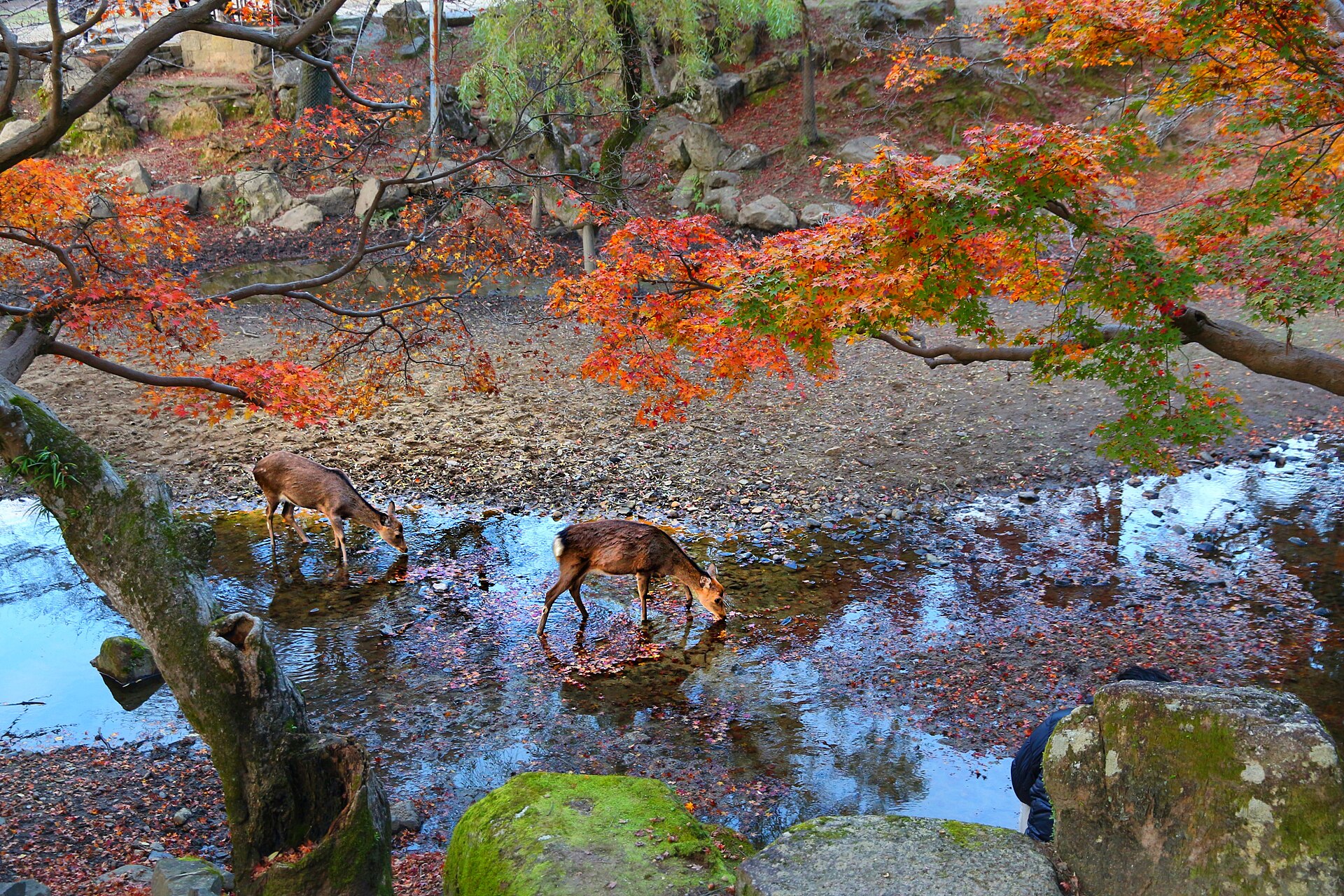
Nara was Japan’s capital for 74 years, from 710 to 784, and it still feels like a place built on a grand scale: a Buddha hall that dwarfs the people inside it, a park with no gates, and wild deer that walk through town as if they owned it. It’s also close enough to Kyoto and Osaka for a day trip, and rewarding enough that many travelers wish they’d stayed longer.
| Capital | 710 to 784 (Heijo-kyo) |
|---|---|
| Nara Park | opened 1880, about 502 hectares, free, open at any hour |
| Deer | about 1,300, a national natural monument since 1957 |
| Great Buddha | about 14.7 m, consecrated 752 |
| UNESCO | Historic Monuments of Ancient Nara, 1998 |
A short history of Nara
The court moved to Heijo-kyo, today’s Nara, in 710 and stayed until 784, when it moved to Nagaoka-kyo. The big Buddhist temples stayed behind, which is why Nara kept its character as a temple city long after the emperors left. Because Nara was not hit by large-scale air raids in the war, many of its old buildings and neighborhoods survived. In 1998 UNESCO listed the Historic Monuments of Ancient Nara as a World Heritage Site.
What to see in Nara
Todai-ji and the Great Buddha
Todai-ji is the reason most people come. Its central image, the Great Buddha (Daibutsu), stands about 14.7 meters tall. It was consecrated in 752, and the hall that houses it was finished in 758. That hall burned in the Middle Ages, and the one you see today was rebuilt in 1709 on a smaller scale than the original, which is still among the largest wooden buildings in the world. The Great Buddha has also been repaired many times, and only parts of the lotus pedestal date from the original.
Nara Park and the deer
Nara Park opened in 1880 and covers about 502 hectares, or about 660 if you count the temples around it. There are no walls, fences or gates, no admission fee, and it’s open at any hour. Around 1,300 deer live in and around the park. They’re designated a national natural monument, and they’ve been treated as messengers of the Kasuga shrine for more than a thousand years.
The deer are wild animals, not pets. They’re used to people and they will nudge, nibble and bow for the special crackers sold by vendors in the park, but they can also bite or butt, especially in the autumn rut and around fawns. Feed them only the crackers sold for the purpose, keep paper and plastic bags out of reach, and don’t tease them. A long-running story says the deer learned to bow from the Fujiwara nobles who bowed to them as messengers of the gods.
Kasuga Taisha and Kofuku-ji
The Kasuga shrine, founded in 767, is the Fujiwara clan’s shrine and sits at the edge of a primeval forest that has been protected for centuries. Kofuku-ji, the Fujiwara family temple, stands near the park’s western edge and was once one of the most powerful institutions in the region.
Naramachi
South of the park, Naramachi is a former merchant district with narrow lanes and wooden townhouses from the Edo period. It’s a good place for a late lunch and a quieter walk once the park crowds thin out.
When to go
Nara is mild: the average annual temperature is 15.7 °C, with about 1,365 mm of rain a year and very little snow. Spring is the cherry blossom season, and the Ukimido pavilion on the pond near the park is a popular blossom spot. Autumn brings red maples in the park. Events include the Shuni-e rites at Todai-ji in March, the Shosoin treasure exhibition in autumn, and the Kasuga Wakamiya On-matsuri festival. Check the dates for the year you go.
Getting there and how long to stay
Nara is under an hour by train from both Kyoto and Osaka, via the Kintetsu or JR lines, so a day trip works well. The park and Todai-ji, Kasuga Taisha and Kofuku-ji are all within a long walk of each other. Stay a night if you’d like to see the park early or late, when the day-trip crowds have gone, or if you plan to add Horyu-ji or the Yamanobe-no-michi walking path. See our guides to Kyoto and Osaka, and our Japan tour packages for routes that combine the three.
Planning Nara with Absolute Asia Tours
Absolute Asia Tours has planned private trips in Asia since 1989. In Nara that usually means a private guide who can explain the temples and the history behind the deer, a driver for the transfer from Kyoto or Osaka, and an early start so you reach Todai-ji before the tour buses. We’re rated 4.8 out of 5 across about 900 traveler reviews. Have a look at our Japan tours or tell us your dates.
Sources (read in Japanese, Japanese Wikipedia): 奈良市, 東大寺, 奈良公園, 春日大社. Last checked November 2026.
Nara: FAQ
How many days do you need in Nara?
One day covers the park, Todai-ji, Kasuga Taisha and Naramachi. Stay a night if you want quiet mornings or a trip to Horyu-ji.
Is Nara Park free?
Yes. The park has no gates and no admission fee and is open at any hour. Some temples and shrines inside it charge for entry.
Can you feed the deer in Nara?
Yes, with the special crackers sold in the park. The deer are wild, so keep your distance from fawns and don’t tease them.
How tall is the Great Buddha at Todai-ji?
About 14.7 meters. It was consecrated in 752.
How far is Nara from Kyoto and Osaka?
Under an hour by train from each.
What is the best time to visit Nara?
Spring for cherry blossoms and autumn for red maples, though the park is pleasant at any time of year.
Photo: Marek Ślusarczyk (Tupungato), Wikimedia Commons, CC BY 3.0.
