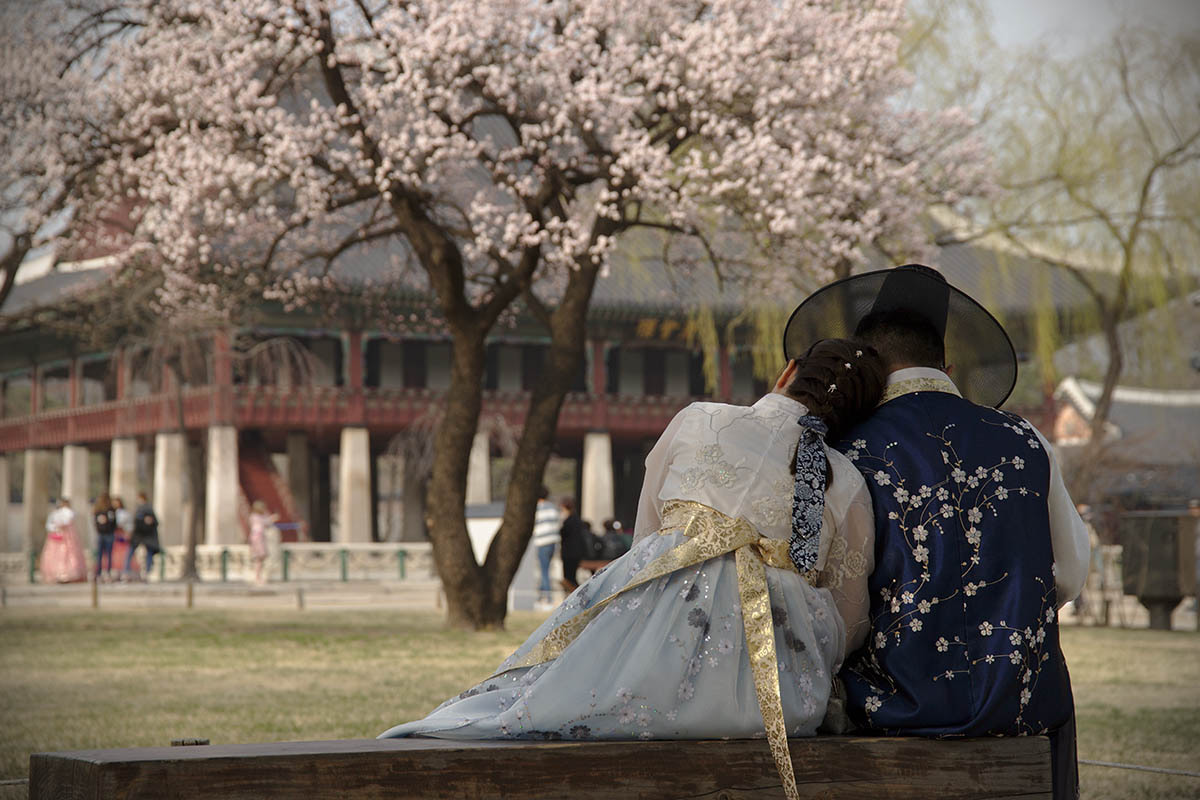
Seoul is the capital of South Korea, on the Han River about 60 kilometers from the Yellow Sea. Together with Gyeonggi Province and Incheon it forms the capital region. It covers 605.25 square kilometers, only 0.61% of the country’s land, and held 9,315,066 people in the 2025 census, about 18.0% of the national population. The river splits it into the northern Gangbuk and southern Gangnam sides, and it has 25 districts.
| Area and people | 605.25 km²; 9,315,066 residents in 2025; 25 districts |
|---|---|
| Capital since | 1394, when the Joseon dynasty moved its capital to Hanyang; Baekje’s capital here from 18 BC to 475 |
| Subway | 11 lines, 359.86 km; rail and subway carry 44.6% of trips |
| World Heritage in Seoul | Jongmyo Shrine, Changdeokgung Palace and part of the Joseon royal tombs |
| Visitors | 14.54 million foreign visitors in 2025, a record; 76.8% of foreigners visiting Korea go to Seoul |
| Gwangjang Market | opened 1905; described as Korea’s first permanent market |
A short history
People have lived in the Seoul area since the Neolithic, and the Baekje kingdom had its capital here from 18 BC to 475. The Goryeo dynasty set up a secondary capital called Namgyeong. In 1394 the Joseon dynasty moved its capital to Hanyang, and Seoul stayed the capital of Joseon and the Korean Empire. Under Japanese rule it was called Gyeongseong. It was split off from Gyeonggi Province as a special city in 1946 and became Seoul Special City in 1949. The Korean War left it in ruins, and after it absorbed surrounding areas in 1963 it more than doubled in size, then grew quickly through industrialization and development south of the river. Its population passed ten million in 1988. It hosted the 1988 Summer Olympics and the 2010 G20 summit.
What to see
- Gyeongbokgung Palace. Founded in 1395, burned in the Imjin War of 1592 and rebuilt from 1865. See our things to do in Seoul guide for the day-by-day plan.
- Changdeokgung and Jongmyo. UNESCO-listed in Seoul; the Seoul City Wall has been put forward for listing as well.
- Bukchon and Gwangjang Market. Hanok lanes and one of the city’s oldest markets. Bukchon has visiting-hour limits for residents, so check current rules.
- Han River. Parks and cycle paths along the river on both sides.
Getting around
The subway is the backbone, with 11 lines and 359.86 kilometers of track, and it carries the largest share of trips, 44.6% of all those by rail and subway. A transit card and a Korean map app help; see the guide above for details. Seoul has become more visited each year: it reached 14.54 million foreign visitors in 2025, the most since records began, and in the same year entered the top ten of Euromonitor’s city destination index for the first time.
Planning Seoul with Absolute Asia Tours
Absolute Asia Tours has planned private trips in Asia since 1989. For Seoul that means a guide who sequences the palaces and neighborhoods, restaurant bookings, and day trips to the DMZ or Suwon. We’re rated 4.8 out of 5 across about 900 traveler reviews. See our South Korea tours or tell us your dates. Our Korea DMZ tour page covers the border trip.
Sources (read in Korean, Korean Wikipedia): 서울특별시. Last checked November 2026.
Seoul: FAQ
How big is Seoul?
605.25 square kilometers, with 9,315,066 residents in the 2025 census.
How long has Seoul been a capital?
Since 1394, when the Joseon dynasty moved its capital to Hanyang. Baekje also had its capital here from 18 BC to 475.
How many subway lines does Seoul have?
Eleven lines with 359.86 kilometers of track.
Which Seoul sites are World Heritage?
Jongmyo Shrine, Changdeokgung Palace and part of the Joseon royal tombs.
How many foreign visitors does Seoul get?
14.54 million in 2025, a record.