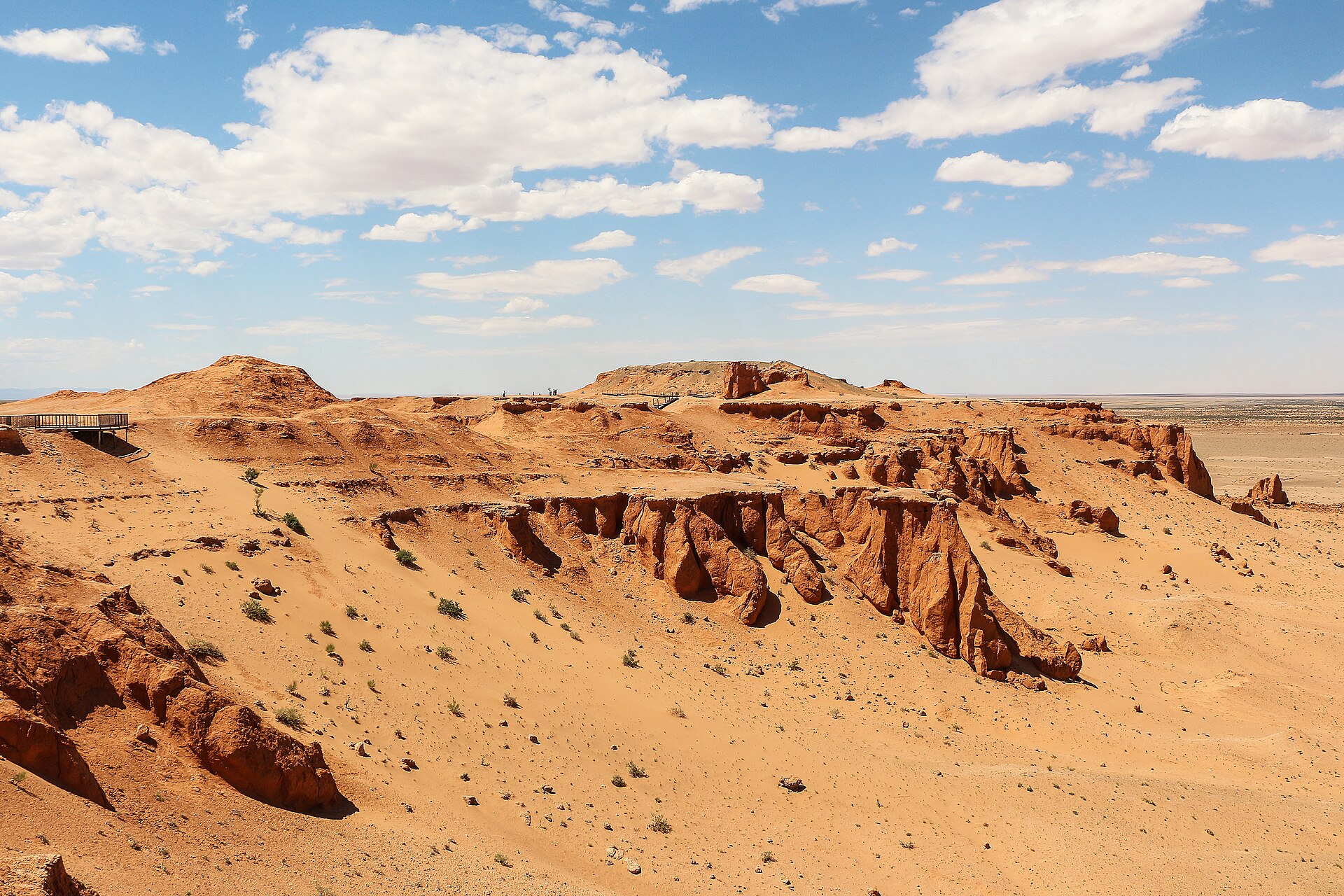
The Gobi is one of the largest deserts on Earth and a cold one, a huge, thinly populated area of rock, gravel and steppe along the border between Mongolia and China. People often picture rolling sand dunes, but most of the Gobi is something different, and the way travelers see it differs between the two countries.
| Location | southern Mongolia and northern China |
|---|---|
| Surface | about 70% bare rock and gravel |
| Jiayuguan | built 1372, inner city 640 m around and 10.7 m high |
| Size rank | fifth or sixth largest desert (sources differ) |
| Climate | cold desert |
Where is the Gobi Desert?
The Gobi lies in southern Mongolia and northern China. Mongolia has East Gobi, Middle Gobi and South Gobi provinces, and on the Chinese side the desert reaches across Inner Mongolia and the western end of the Hexi Corridor in Gansu. Sources disagree on its rank, calling it the fifth or sixth largest desert in the world, so it’s safest to say that it’s among the largest. It’s a cold desert: winters are very cold, and it gets little rain because mountain ranges, including the Himalaya, block the clouds.
What kind of desert is it?
The word gobi is Mongolian and means a desert, a gravel plain or a dry place. In Chinese, the word describes a stony semi-desert rather than a sandy one. About 70 percent of the Gobi is bare bedrock and gravel, with sparse plants covering less than 10 percent of the ground, and the stones are often coated in a dark brown film that makes the surface look black. Sand dunes exist, but they cover only a small part.
The Silk Road edge in China
Jiayuguan
The fortress at Jiayuguan is the first pass at the western end of the Ming Great Wall, and it was built in 1372. It stands in a narrow valley where the wall runs out across the gravel desert on both sides. The inner city is 640 meters around and 10.7 meters high, built of rammed earth, and it’s counted as the best-preserved pass on the Great Wall. There is also a museum devoted to the Great Wall. A local legend says the builder worked out that the pass needed exactly 99,999 bricks, and the single brick left over is still on the west gate tower; builders called it the stone that keeps the city standing.
Dunhuang
Further west, the oasis of Dunhuang has the Mogao Caves and Crescent Spring at the foot of the Mingsha dunes. See our guide to Dunhuang.
The Mongolian Gobi
The Mongolian side is wilder and more remote, with long drives between camps. One of its best-known stops is the Flaming Cliffs at Bayanzag, red sandstone bluffs famous for dinosaur fossil finds in the 1920s. Bactrian camels live in the region, and travelers stay in ger camps. For a Mongolian trip you’ll need a driver and guide who know the routes, since there are few roads and little signal.
When to go
Late spring to early autumn is the most practical season, since winters are bitterly cold. Dust storms from the Mongolian plateau can reduce visibility, especially in spring. Bring layers, because desert nights are cold even in summer.
Planning the Gobi with Absolute Asia Tours
Absolute Asia Tours has planned private trips in Asia since 1989. For the China side that means a route from Xi’an or Lanzhou through Jiayuguan to Dunhuang, with the Silk Road explained on the way. See our Xi’an guide and our China tours, or tell us your dates. We’re rated 4.8 out of 5 across about 900 traveler reviews.
Sources (read in Chinese, Chinese Wikipedia): 戈壁, 嘉峪关, 巴彦扎格. Last checked November 2026.
Gobi Desert: FAQ
Where is the Gobi Desert?
In southern Mongolia and northern China.
Is the Gobi a sand desert?
Mostly not. About 70 percent of it is bare rock and gravel. Sand dunes cover only a small part.
What does Gobi mean?
In Mongolian it means a desert, a gravel plain or a dry place.
Is the Gobi hot or cold?
It’s a cold desert, with bitterly cold winters and cold nights even in summer.
What is Jiayuguan?
The first pass at the western end of the Ming Great Wall, built in 1372.
When is the best time to visit the Gobi?
Late spring to early autumn.
Photo: Bernard Gagnon, Wikimedia Commons, CC0. The Flaming Cliffs at Bayanzag, in the Mongolian Gobi.
