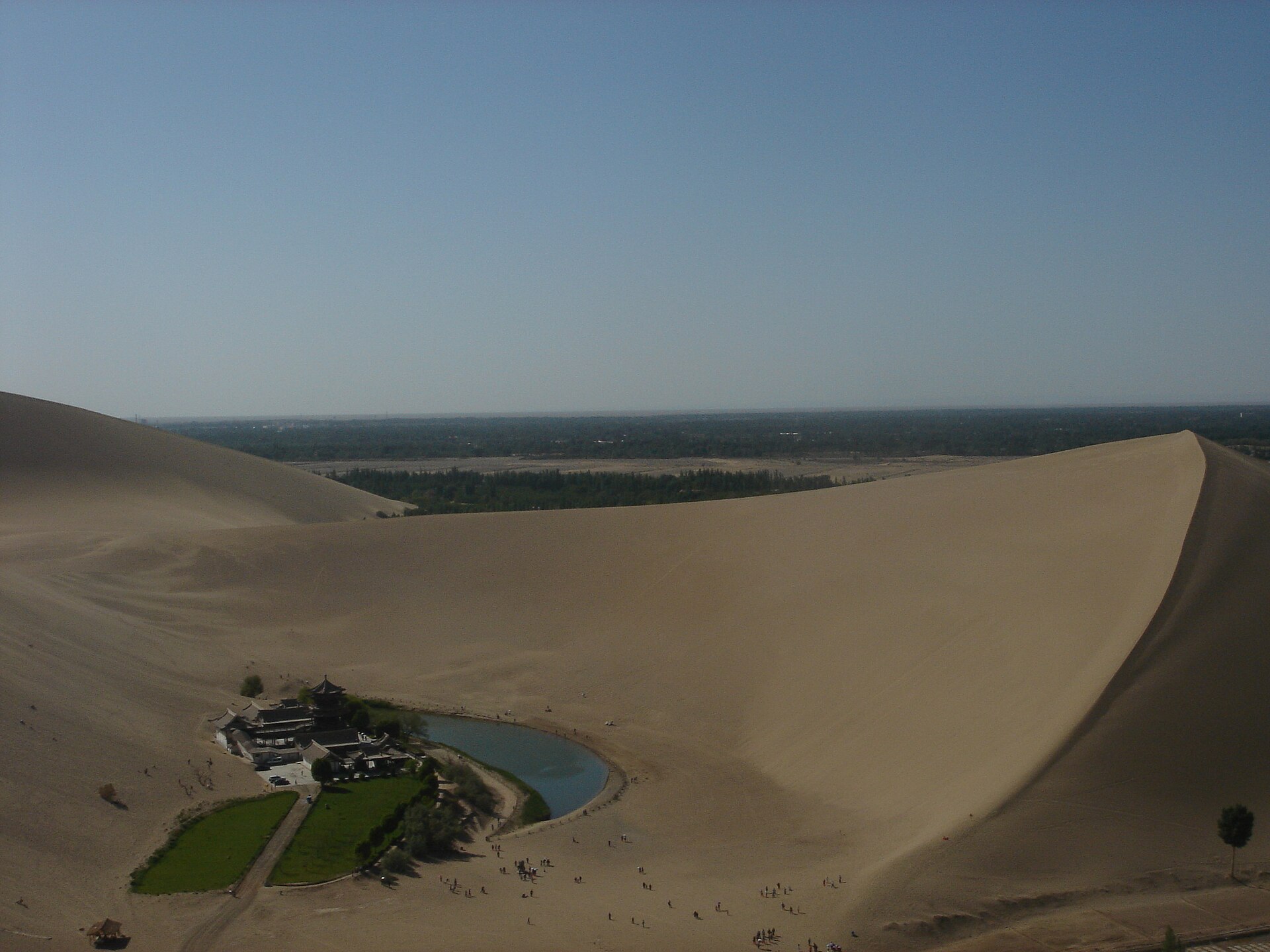
Dunhuang is a small oasis city in the far west of Gansu, at the end of the Hexi Corridor, where the Silk Road left China and crossed the desert. Its caves hold one of the world’s great collections of Buddhist art, and its sand dunes and crescent-shaped spring look like a movie set. It’s remote enough that most travelers fly in, and it’s worth the effort.
| Mogao Caves | 735 caves, about 45,000 m² of murals, UNESCO December 1987 |
|---|---|
| First cave | 366 AD |
| Library Cave | found 1900, over 50,000 items |
| Crescent Spring | about 5 km southwest of the city |
| Climate | about 42 mm of rain a year |
The Mogao Caves
The Mogao Caves are cut into a cliff 25 kilometers southeast of the city, a line of grottoes 1,680 meters long and up to five levels high. According to a Tang-dynasty record, the first cave was dug in 366 AD by a monk named Lezun, who saw golden light on the cliff, as though a thousand Buddhas had appeared. Work continued over the next thousand years, through the Sui, Tang, Five Dynasties, Western Xia and Yuan periods.
Today there are 735 caves, with about 45,000 square meters of murals and 2,415 painted clay sculptures, and 492 caves are in good condition. It’s the largest and richest site of Buddhist art in the world. UNESCO listed it in December 1987.
The Library Cave
In 1900 a Daoist priest named Wang Yuanlu, who was clearing sand from a cave, found a small hidden chamber (now Cave 17) packed with more than 50,000 manuscripts and other objects. The discovery gave rise to a whole field of scholarship, Dunhuang studies. Many of the manuscripts are now held in collections outside Dunhuang.
Not all the caves are open at any one time, and visits to Mogao are normally managed by timed entry, so book ahead and ask your guide which caves your ticket includes.
Crescent Spring and the Mingsha dunes
About five kilometers southwest of the city, a crescent-shaped spring sits at the foot of the Mingsha (“singing sand”) dunes. It has been counted among the “eight views of Dunhuang” since the Han dynasty. Scientists who studied it between 1997 and 2002 concluded that groundwater rises into a hollow between two alluvial fans, and that the water level depends on the water table. The level dropped for decades, and an emergency program started in 2008 to restore it. Climb the dune at sunset and expect to share it with other visitors.
The Silk Road gates
The Dunhuang area was a military and trade center from the Han dynasty, when the Dunhuang commandery was set up in 111 BC. Ruins of the Han-dynasty Great Wall and the two frontier passes, Yumen Pass and Yang Pass, still stand in the desert around the city. They’re remote and quiet, and best visited with a driver.
When to go
Dunhuang is a desert: it averages only 42 millimeters of rain a year, and its mean annual temperature is 9.5 °C, so summers are hot and winters cold. Spring and autumn are the most comfortable. See our guides to Xi’an, the usual starting point for a Silk Road route, and our China tours.
Planning Dunhuang with Absolute Asia Tours
Absolute Asia Tours has planned private trips in Asia since 1989. In Dunhuang that means a guide who knows the caves and can read the murals, pre-booked entry to Mogao, and a driver for the desert sites. We’re rated 4.8 out of 5 across about 900 traveler reviews. Tell us your dates and we’ll plan from there.
Sources (read in Chinese, Chinese Wikipedia): 敦煌市, 莫高窟, 玉门关. Last checked November 2026.
Dunhuang: FAQ
How many caves are there at Mogao?
735, of which 492 are in good condition, with about 45,000 square meters of murals.
When were the Mogao Caves founded?
The first cave was dug in 366 AD, according to Tang-dynasty records.
What is the Library Cave?
A sealed chamber found in 1900 with more than 50,000 manuscripts and other objects.
Where is Crescent Spring?
About five kilometers southwest of Dunhuang, at the foot of the Mingsha dunes.
What is the best time to visit Dunhuang?
Spring and autumn. It’s very dry, with hot summers and cold winters.
How do you get to Dunhuang?
Most travelers fly in. Check current flight and train options when you plan.
Photo: Roy kiki, Wikimedia Commons, CC BY-SA 3.0.
