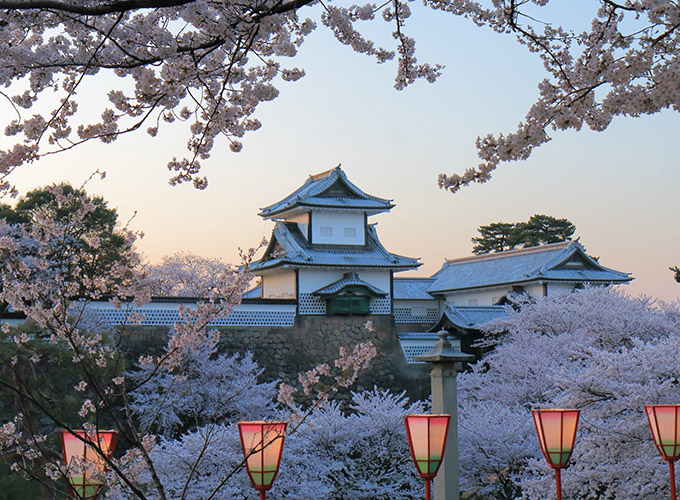
Kanazawa is a castle town on the Sea of Japan coast that kept much of its old character: a major garden, a preserved geisha district, lanes of samurai houses, and a market that’s been feeding the city for three centuries. It’s often called a quieter alternative to Kyoto, and it’s best seen at a slower pace than most Japan itineraries allow.
| Kenroku-en | about 11.7 ha, begun 1676, opened to the public 1874 |
|---|---|
| Higashi Chaya | tea district opened 1820 |
| Omicho Market | since 1721, about 170 to 180 shops |
| 21st Century Museum | opened 2004; closure planned May 2027 to about March 2028 |
| From Tokyo | about 2.5 hours by Hokuriku Shinkansen |
Kenroku-en
Kenroku-en is one of Japan’s three great gardens, alongside Korakuen in Okayama and Kairakuen in Mito. It covers about 11.7 hectares next to Kanazawa Castle and began in 1676, when the lord Maeda Tsunanori built a villa and a lotus pond on the slope facing the castle. The garden was named Kenroku-en in 1822, after the six qualities that a perfect garden was said to combine: spaciousness, seclusion, artifice, antiquity, water and views. It was a private garden of the lords for two centuries and opened to the public in 1874. It earned three stars in the 2009 Michelin travel guide.
The garden is lovely in every season, and it’s known for cherry, plum and maple color. In winter, the gardeners tie the pine branches to tall poles with ropes in a conical pattern called yukitsuri, to stop them breaking under snow, and the result has become the garden’s winter signature.
Higashi Chaya and the old geisha districts
East of the city center, across the Asano River, the Higashi Chaya district is a small, tidy area of wooden tea houses with lattice fronts, laid out when the lords of the Kaga domain licensed the district in 1820. It covers only about 1.8 hectares, and national authorities listed it as a preservation district in 2001. The Shima tea house is open to the public and is an Important Cultural Property. Nearby, Kazue-machi is another preserved tea-house district along the river.
Nagamachi samurai district
West of the Korinbo shopping area, Nagamachi has earthen walls and stone-paved lanes from the days when samurai of the Kaga domain lived here. Most houses are private homes, but the Nomura family house, a retainer’s residence, is open, and its garden is highly regarded. In winter, the earthen walls are covered with straw mats to protect them from snow and frost.
Omicho Market
Omicho is Kanazawa’s main fresh food market, known locally as the city’s kitchen. It has operated since 1721, when the fish markets were brought together on this site, and today about 170 to 180 shops and restaurants sell local seafood, Kaga vegetables and snacks. Go in the morning for the best choice, and eat there: the stalls and small restaurants serve seafood bowls and grilled shellfish. It’s about 15 minutes’ walk from Kanazawa Station.
Gold leaf
Kanazawa is Japan’s main producer of gold leaf, beaten to a thickness of about 0.0001 millimeter, and you’ll see it on lacquerware, screens and in food. Sellers here serve soft-serve ice cream covered in sheets of leaf; it adds no taste or texture, only looks. Some workshops let you try applying gold leaf to a small craft piece.
21st Century Museum of Contemporary Art
The museum’s round glass building, 112.5 meters across, opened in 2004 on a lawn in the city center and is built to be walked around as well as visited. Kanazawa city has announced a plan to close the museum from May 2027 to about March 2028 for renovation, including repair of ceilings damaged in the January 2024 Noto earthquake. Check the museum’s website before you go if your trip falls in 2027 or early 2028.
When to go and getting there
Spring (cherry blossoms) and autumn (maples) are the most popular seasons, and winter is a good time for the garden’s snow ropes, though the Sea of Japan coast is cold and snowy. Kanazawa is on the Hokuriku Shinkansen, about two and a half hours from Tokyo, and it combines well with the Japanese Alps. See our guides to Takayama, Kyoto and Japan in winter, or our Japan tour packages.
Planning Kanazawa with Absolute Asia Tours
Absolute Asia Tours has planned private trips in Asia since 1989. For Kanazawa that means a private guide to put the garden, the geisha district and the samurai lanes in context, a visit to Omicho at the right hour, and a ryokan or a gold-leaf workshop booked in advance. We’re rated 4.8 out of 5 across about 900 traveler reviews. Have a look at our Japan tours or tell us your dates.
Sources (read in Japanese, Japanese Wikipedia): 金沢市, 兼六園, 金沢21世紀美術館. Last checked November 2026.
Things to do in Kanazawa: FAQ
How many days do you need in Kanazawa?
Two days covers Kenroku-en, the old districts, the market and the museum without rushing.
What is Kenroku-en famous for?
It’s one of Japan’s three great gardens, and it’s known for its seasonal color and the winter snow ropes on its pines.
What is Higashi Chaya?
A preserved district of 19th-century tea houses, licensed in 1820, where geisha entertained guests.
Why is Kanazawa known for gold leaf?
It’s Japan’s main production area. The leaf is used on crafts and appears on food such as soft-serve ice cream.
Is the 21st Century Museum closing?
Kanazawa city has announced a plan to close it from May 2027 to about March 2028 for renovation. Check before you go.
How do you get to Kanazawa from Tokyo?
By the Hokuriku Shinkansen, in about two and a half hours.