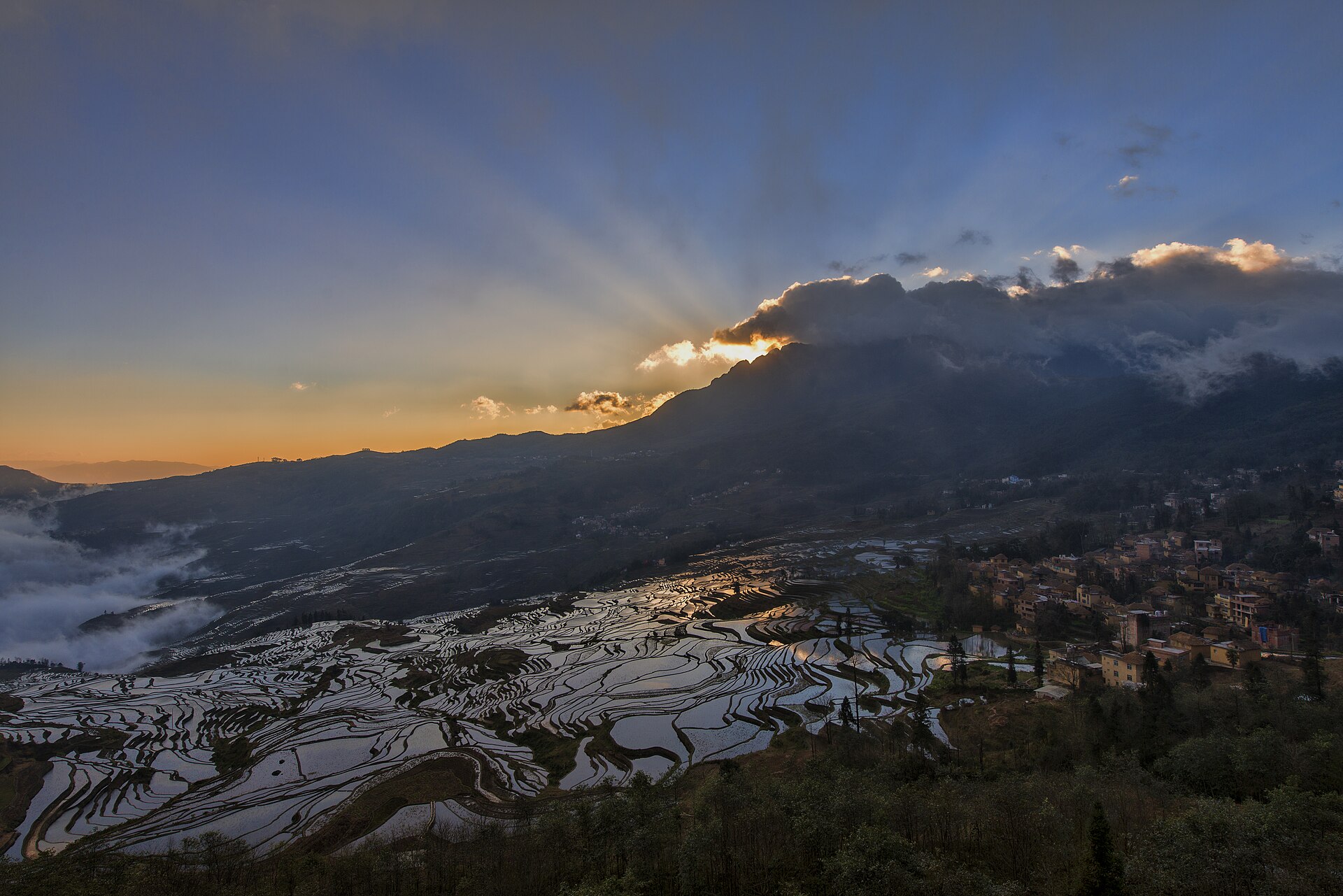
The terraces around Yuanyang, in southern Yunnan, are among the most dramatic in Asia. They descend the Ailao Mountains in thousands of narrow steps, and when the fields are flooded they catch the sky and turn silver, gold and pink. UNESCO listed them in 2013 as a cultural landscape, because they are a working farming system that the Hani people have kept going for about 1,300 years.
| UNESCO | 22 June 2013 |
|---|---|
| Heritage area | 16,603 ha, buffer 29,501 ha |
| Villages | 82 in the heritage area |
| Farmed by the Hani | about 1,300 years |
| Structure | forest, village, terrace, water |
What UNESCO listed
The Honghe Hani Rice Terraces are in the Honghe Hani and Yi Autonomous Prefecture, across the counties of Yuanyang, Honghe, Jinping and Lüchun, with the core area in Yuanyang. UNESCO inscribed them on 22 June 2013. The heritage area covers 16,603 hectares, with a buffer zone of 29,501 hectares. In places there are more than 3,000 terraces between the forest edge and the valley floor.
How the system works
The terraces sit on the south side of the Red River in the Ailao Mountains. They follow a four-part pattern, from top to bottom: forest, village, terrace and water. The forest above 2,000 meters catches rain and feeds streams, and a network of sandstone channels carries the water down to every field. The villages sit between 1,400 and 2,000 meters, under the forest and above the fields. There are 82 villages in the heritage area, each with 50 to 100 households, and families farm the terraces below their houses, mainly growing red rice and keeping livestock. Rice growing is part of the Hani calendar, beliefs and community life as well as a livelihood.
When to go
The terraces look different at different times of the farming year. They’re usually flooded in winter and early spring, which is the time for the shining, mirror-like views, and in summer they’re green. Mist is common in the mornings, so build in more than one day for views. Check local conditions with your guide, as the timing of flooding and planting varies from year to year.
Viewpoints and villages
Several viewpoints around Yuanyang look out over different sections of the terraces, and sunrise and sunset are the best times because the low light makes the water shine. Beyond the viewpoints, walk down into a village if you can: the houses are built of earth and stone, and you’ll see how the water channels, paths and fields fit together.
Getting there and how long to stay
Yuanyang is a long drive from Kunming, so most travelers stay two nights near the terraces. See our guides to Kunming and the Longji terraces, and our China tours.
Planning Yuanyang with Absolute Asia Tours
Absolute Asia Tours has planned private trips in Asia since 1989. For Yuanyang that means a driver for the long road from Kunming, a guide who knows the viewpoints and villages, and a stay timed for the flooded fields. We’re rated 4.8 out of 5 across about 900 traveler reviews. Tell us your dates and we’ll plan from there.
Sources (read in Chinese, Chinese Wikipedia): 红河哈尼梯田, 元阳县. Last checked November 2026.
Yuanyang rice terraces: FAQ
Are the Yuanyang terraces a World Heritage Site?
Yes. The Honghe Hani Rice Terraces were listed by UNESCO on 22 June 2013.
How old are the terraces?
The Hani people have farmed them for about 1,300 years.
How many villages are in the heritage area?
82, each with about 50 to 100 households.
When are the terraces flooded?
Usually in winter and early spring. Check local conditions, as timing varies.
How many days do you need in Yuanyang?
Two nights, to catch sunrise and sunset.
Where is Yuanyang?
In southern Yunnan, in the Honghe Hani and Yi Autonomous Prefecture.
Photo: chensiyuan, Wikimedia Commons, CC BY-SA 4.0.
