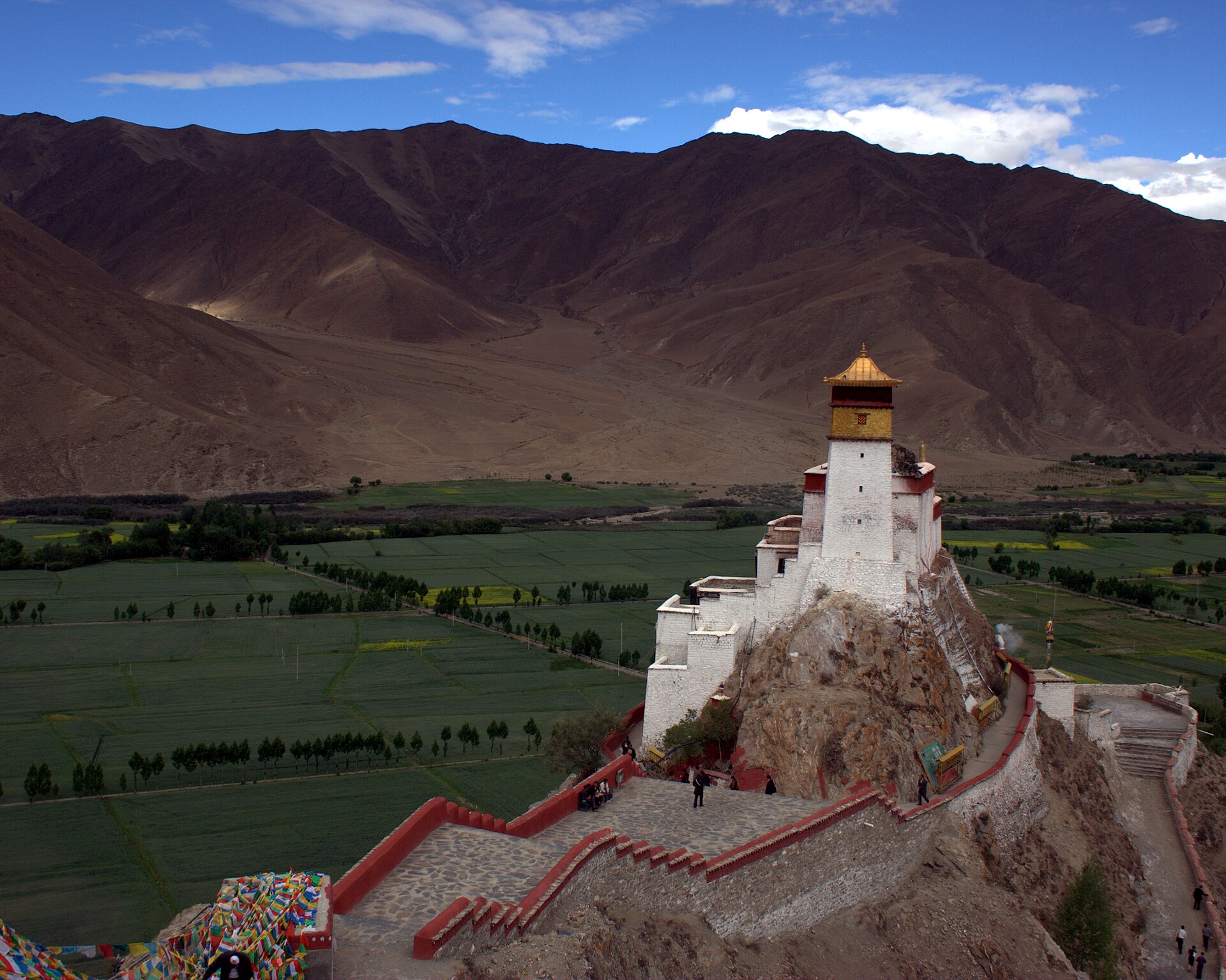
| Yumbulagang | said to have been built by Nyatri Tsenpo in 127 BC as Tibet’s first palace; the three-story tower now seen was rebuilt after 1982 |
|---|---|
| Samye Monastery | laid out in 762 and finished in 775; the first Tibetan monastery with ordained monks; national protected site since 1996; 4A since 2005 |
| Samye’s first monks | seven noble youths ordained by Santarakshita, the ‘seven test men’ |
| Tsetang | a town in Nedong district, Shannan prefecture, on the south bank of the Yarlung Tsangpo |
Tibet – Getting to know Tsetang
The Yarlung Tsangpo is known as Tibet’s Mother River. It runs from the Gyima Yangzong Glacier across the Tibetan Plateau, passing through the deepest canyon in the world, and eventually finishing 1,700 miles later in the Bay of Bengal. Around a third of the population dwell in the fertile lands around the Yarlung Tsangpo, and if they were ever to trace their ancestry, they would find themselves back at the river’s middle section, where on the south bank lies the city of Tsetang, capital of Shannan (Lhoka) prefecture, and the cradle of Tibetan civilization.
Tibet Tsetang Travel Guide
Tsetang is a city of royal, religious and rural firsts. Firstly (sorry!), the Yumbu Lhakhang Palace here is said to have been the first palace in Tibet, said to have been built in the 2nd century BC for the king, and still standing today. In terms of religion, the 8th century Samye Monastery is thought to be the country’s first Buddhist gompa. And (final first, we promise) according to local legend, the first field ever to be farmed in Tibet can be found near Tsetang in the Yarlung Valley.
Once the seat of mighty emperors wanting to control trade routes into Bhutan and India, Tsetang is now a Chinese military and administrative base, with a modern centre, and effectively merged with the nearby city of Nedong. But there remains a charming old Tibetan quarter, bunched around the base of the sacred mountain Gangpo Ri, from where you can conveniently explore the fascinating historic temples, monasteries, caves and stupas of the Yarlung Valley.
Famed for the quality of the apples and pears that originate here, the valley terrain is ruggedly beautiful with a climate that is pleasantly mild. Sand dunes bank up against the meandering river, while the landscape is dotted with pure springs, crystalline lakes and dramatic mountain peaks. There could hardly be a finer place for the story of Tibet to begin.
What to do in Tsetang
The Samye Monastery is laid out in a mandala shape according to the tenets of Buddhist cosmology, with a main temple representing a fabled palace atop Mt. Meru, and over 1000 chortens serving as a ring of mountains surrounding the universe. Not just Tibet’s earliest monastery but also its first university, Samye hosted a debate in the 8th century to decide whether the country would follow Indian Buddhism or Chinese Zen Buddhism. Indian influence won the day.
A long hike above Samye brings you to the Chim-puk Hermitage. This network of caves was used as a meditation retreat by many notable Buddhist figures, including the Guru Rinpoche, and is now inhabited by nuns who embrace a simple life amid a landscape of breathtaking natural beauty.
Just outside Tsetang, the Trandruk (Changzhug) Monastery is a very early geomantic structure and one of many said to have been built by Songtsen Gampo to trap an unruly ogress. The temple’s best-known treasure is a stunning thangka inlaid with thousands of pearls, said to have been made by Princess Wencheng, Songtsen Gampo’s Chinese wife.
Around Tsetang
Branching off the Yarlung Valley to the southwest is the ‘Valley of the Kings’. Estimates vary as to the number of tombs here, but there are at least 11 of them, great mounds of earth that blend seamlessly into the hilly scenery. It is believed that these weather-beaten burial mounds contain ancient rulers including, possibly, Songtsen Gampo, the 7th century king and founder of the Tibetan empire.
The tower of the Yumbu Lhakhang Palace is only 11 metres high, yet it seems much taller because of its strategic position on a ridge overlooking the Yarlung Valley. The origins of this historic fortress are shrouded in the mysteries of time, but the current structure has been completely rebuilt following the damage it suffered during the Cultural Revolution. As you might expect, the views are nothing short of mindblowing.
select another destination
Look down from the Yumbu Lhakhang Palace and you can see Zortang, believed to be the first field ever cultivated in Tibet. Farmers will often take a handful of the soil from here to sprinkle on their own fields, in the hope of a good harvest.
An unusual origin myth
Thousands of devotees make a pilgrimage every year to a modest cave close to the summit of Gangpo Ri. It is here, according to an ancient legend from the Bon religion, that a meditating monkey encountered a female demon. An unlikely romance blossomed quickly, and they married, with their offspring going on to form the six tribes of Tibet.
Yumbulagang
Yumbulagang stands on Tashi Tseri hill about five kilometers southeast of Nedong district town, and tradition says the Yarlung chief Nyatri Tsenpo built it in 127 BC as the first palace in Tibet. In the time of the Fifth Dalai Lama it became a temple. It was torn down during the Cultural Revolution, and repair began in 1982. What stands today is a three-story building with a golden pavilion roof on top that the Fifth Dalai Lama added. Its murals tell the story of Tibet’s first king, first building and first field, and the field is said to be nearby. There are statues of Songtsen Gampo and Princess Wencheng inside.
Samye Monastery
Samye sits on the north bank of the Yarlung Tsangpo below Hepori hill. King Trisong Detsen invited the Indian masters Santarakshita and Padmasambhava, and the foundation was laid in 762, with building lasting twelve years to 775. The monastery’s central hall mixes Tibetan, Chinese and Indian styles, which gives it the name Three-Style Temple, and its layout follows a Buddhist cosmology. Seven noble youths were ordained here as the first Tibetan monks. It became a center of the Nyingma school after the 10th century, and was rated 4A in 2005.
Sources (read in Chinese, Chinese Wikipedia): 桑耶寺, 雍布拉康, 泽当镇. Last checked November 2026.
Tsetang: FAQ
What is Yumbulagang?
Tradition says it was Tibet’s first palace, built by Nyatri Tsenpo in 127 BC. The present building was rebuilt after 1982.
When was Samye Monastery founded?
Its foundation was laid in 762 and it was completed in 775.
Why is Samye called the Three-Style Temple?
Its central hall mixes Tibetan, Chinese and Indian styles.
Who were the first monks at Samye?
Seven noble youths, ordained as the first Tibetan monks.
Where is Tsetang?
In Nedong district, Shannan prefecture, on the south bank of the Yarlung Tsangpo.
Photo: Preston Rhea, Wikimedia Commons, CC BY-SA 2.0. Yumbulagang, near Tsetang.
