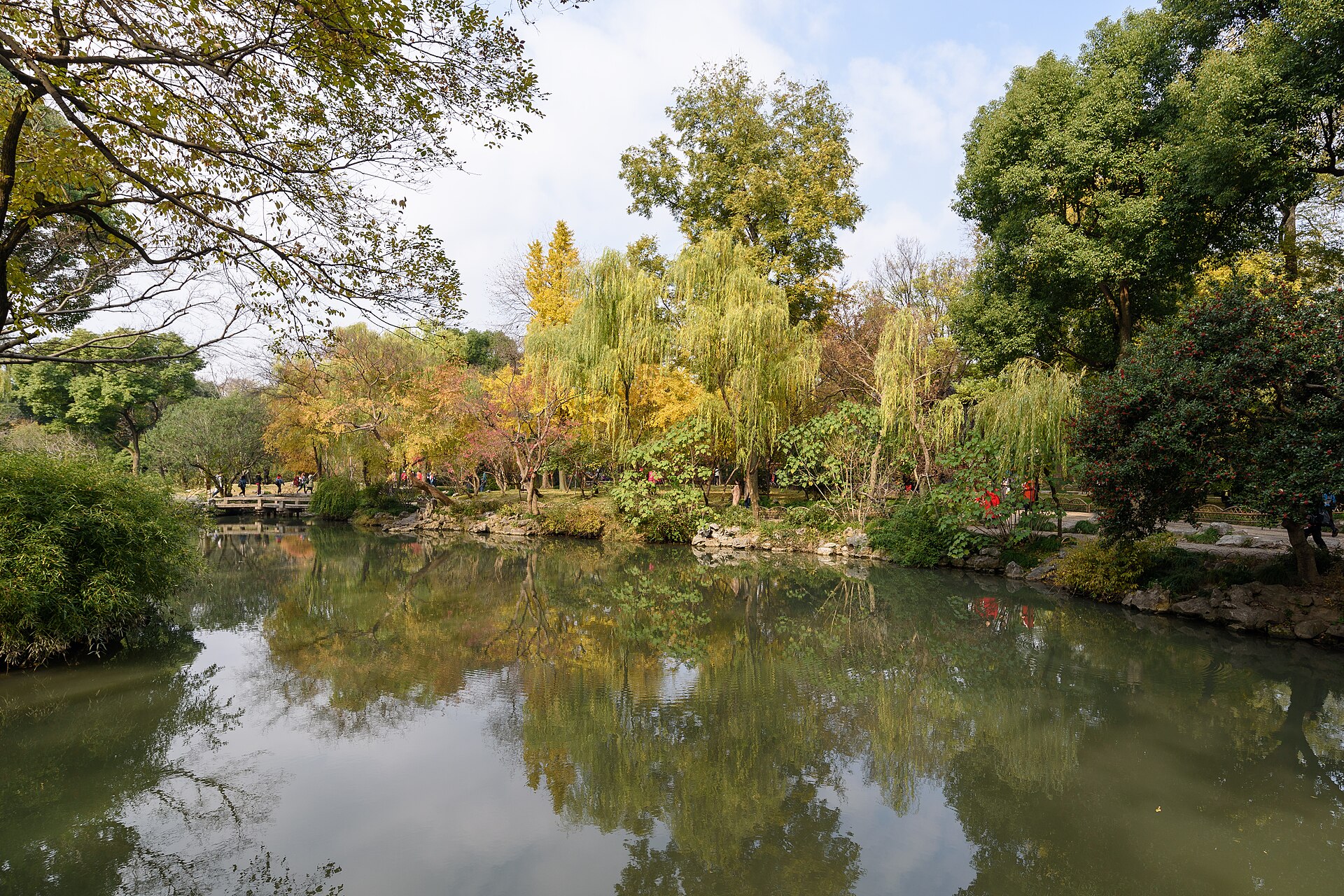
Suzhou is a canal city in southeastern Jiangsu, known for its classical gardens and a saying that pairs it with Hangzhou: “above is heaven, below are Suzhou and Hangzhou.” Chinese sources give it more than 4,000 years of written history and date the founding of the city to 514 BC under the Wu king Helü. Nine of its gardens are a UNESCO World Heritage Site, and it is usually visited as a day or overnight trip from Shanghai.
| Classical gardens | four listed by UNESCO in 1997 (Humble Administrator’s, Lingering, Master of the Nets, Mountain Villa with Embracing Beauty); five added in 2000, nine in all |
|---|---|
| Humble Administrator’s Garden | begun 1509; about 52,000 m²; a national protected site since 1961 |
| Tiger Hill | 5A scenic area; Yunyan Temple Pagoda built 959 to 961 |
| Gardens today | more than 170 in the late Qing; over 60 survive and 19 are open to visitors |
| City founding | 514 BC, under the Wu king Helü |
The classical gardens
Suzhou’s gardens grew from the Wu capital of 514 BC, took shape in the Five Dynasties, matured in the Song, flourished in the Ming and peaked in the Qing. By the end of the Qing there were more than 170 in the area, and over 60 survive, with 19 open to visitors. They are small but use planned views, so the scene changes with each step. UNESCO’s committee said no place better expressed the ideal of recreating a whole world within a small space. In 1997 four gardens were listed, and five more joined in 2000: the Surging Waves Pavilion, the Lion Grove, the Garden of Cultivation, the Couple’s Retreat Garden and the Retreat and Reflection Garden, which is in Wujiang district.
Humble Administrator’s Garden
The largest of the famous four began in 1509, when the censor Wang Xianchen retired and built it on the site of an old temple. The name comes from a line in a Jin dynasty essay about the humble work of tending a garden. It covers about 52,000 square meters in three parts, east, middle and west, and water takes up about a third of the central part, which is the heart of the garden. The painter Wen Zhengming made 31 pictures of it in 1533. It has been open to the public since 1952, and it became a national protected site in 1961.
Tiger Hill
Tiger Hill is a low hill outside the old city. According to the Records of the Grand Historian, the king Helü was buried here after he died in 496 BC. Its best-known sight is the Yunyan Temple Pagoda, built between 959 and 961 and called China’s leaning tower, and the Sword Pond. The Tang poet Bai Juyi, as governor, dug the Shantang canal that runs from the hill to the Chang Gate in 825. The scenic area is rated 5A.
Planning Suzhou
Many travelers see Suzhou as a day trip from Shanghai, but a night in the old city lets you visit the gardens early before the groups arrive. Pick two or three gardens rather than all of them, and pair one with Tiger Hill. Nearby water towns such as Tongli and Zhouzhuang have canals and old merchant houses and are busy in peak seasons. See our guides to Shanghai, Hangzhou and our China tours.
Planning Suzhou with Absolute Asia Tours
Absolute Asia Tours has planned private trips in Asia since 1989. For Suzhou that means a guide who picks the right gardens for your day, a driver from Shanghai or Hangzhou, and a hotel in the old city. We’re rated 4.8 out of 5 across about 900 traveler reviews. See our China tours or tell us your dates.
Sources (read in Chinese, Chinese Wikipedia): 苏州古典园林, 拙政园, 苏州市, 虎丘. Last checked November 2026.
Suzhou: FAQ
How many Suzhou gardens are World Heritage sites?
Nine: four listed in 1997 and five added in 2000.
What is the Humble Administrator’s Garden?
A garden begun in 1509 by the retired censor Wang Xianchen, about 52,000 square meters, and one of the best known in China.
What is Tiger Hill known for?
The Yunyan Temple Pagoda, built between 959 and 961 and often called China’s leaning tower, and the Sword Pond.
Can you visit Suzhou from Shanghai in a day?
Yes, though a night in the old city gives you time for two or three gardens without a rush.
How many gardens are open in Suzhou?
Nineteen of the surviving gardens are open to the public, according to Chinese Wikipedia.
Photo: King of Hearts, Wikimedia Commons, CC BY-SA 4.0. The Humble Administrator’s Garden.
