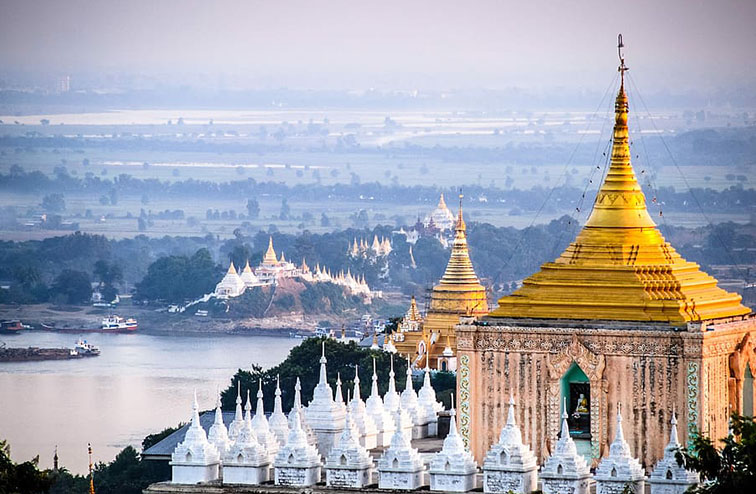
| Location | northern Rakhine State |
|---|---|
| Capital | of the Mrauk U Kingdom from 1430 until 1785 |
| Significance | the largest and most powerful Rakhine kingdom in history |
| People | culturally significant to the Rakhine (Arakanese) |
| Name | said by some Rakhine scholars to mean The First Accomplishment |
Mrauk U: An Introduction
Nestled just below the border with Bangladesh on Burma’s far west coast in the state of Rakhine, the ancient capital of Mrauk U is another of Burma’s key cultural highlights. Located in a predominantly agricultural region, this unassuming town was once the Mrauk U Empire’s splendid capital, a thriving nexus of exotic trade routes from Portugal, Spain, Holland, the Middle East, India, Burma & beyond. Founded around 1430, the kingdom prospered for over 350 years before its demise in the late 18th Century.
An important religious centre for many centuries; temples, some beautiful & some bizarre, are littered throughout the town and further afield into the surrounding countryside amongst working rice paddies and small villages. The key site is the temple of Shitthaung, within who’s walls is hidden a maze of interior corridors, decorated with reportedly 80,000 Buddha images in disorientating spirals around a central chamber (thus the name of the ‘Shrine of 80,000 images’). Close-by, the stocky Htukkanthein Temple appears more of a fortress than its intended role as a place of worship. Other important sites include the ancient library of Pitakataik and the circular Anndawthein Temple. In total over 200 temples and places of archaeological interest have been discovered thus far, with much of the surrounding area still to be excavated.
Whilst it is unfair to compare the site to Bagan, with Mrauk U lacking the scale and much of the ‘wow factor’ of its older brother, Mrauk U is still very much a destination to be considered by those wishing to get to grips with Burma’s less-visited highlights. The journey here is not a hard one but it is long, with most staying a night in Sittwe between the flight from Yangon and the 4 – 7 hour cruise up the Kaladan River.
In the town you’ll find a market, a selection of local restaurants serving regional specialities, and the ruins of the royal palace. The palace complex contains an interesting archaeology museum full of artefacts rescued from the crumbling temples, and a model of the town, which provides a helpful overview of the area (Google Streetmap hasn’t quite got round to it, yet). Other places within reach include several Chin Village’s (still located within Rakhine State) where you can learn more about the unique Chin culture without taking on the complexities of travel to the state, which is often severely restricted.
The Rakhine royal city
English Wikipedia describes Mrauk U as a town in northern Rakhine State, culturally significant to the Rakhine people and home to many important archaeological sites. From 1430 until 1785 it was the capital of the Mrauk U Kingdom, the largest and most powerful Rakhine kingdom in history. Some Rakhine scholars say the name means The First Accomplishment. Rakhine State has been affected by conflict, so we have not verified any access, boat, hotel or price information in the older text. Check current government travel advice and written confirmation from your operator before considering this area.
Sources (read in English, English Wikipedia): Mrauk U. Last checked November 2026.
Mrauk-U: FAQ
What is Mrauk-U?
A town in northern Rakhine State with many archaeological sites.
When was it a capital?
From 1430 to 1785.
Is it open to visitors?
Check current government advice; the region is affected by conflict.
What does the name mean?
Some Rakhine scholars say The First Accomplishment.
Who are the Rakhine?
The Arakanese people for whom the town is culturally significant.