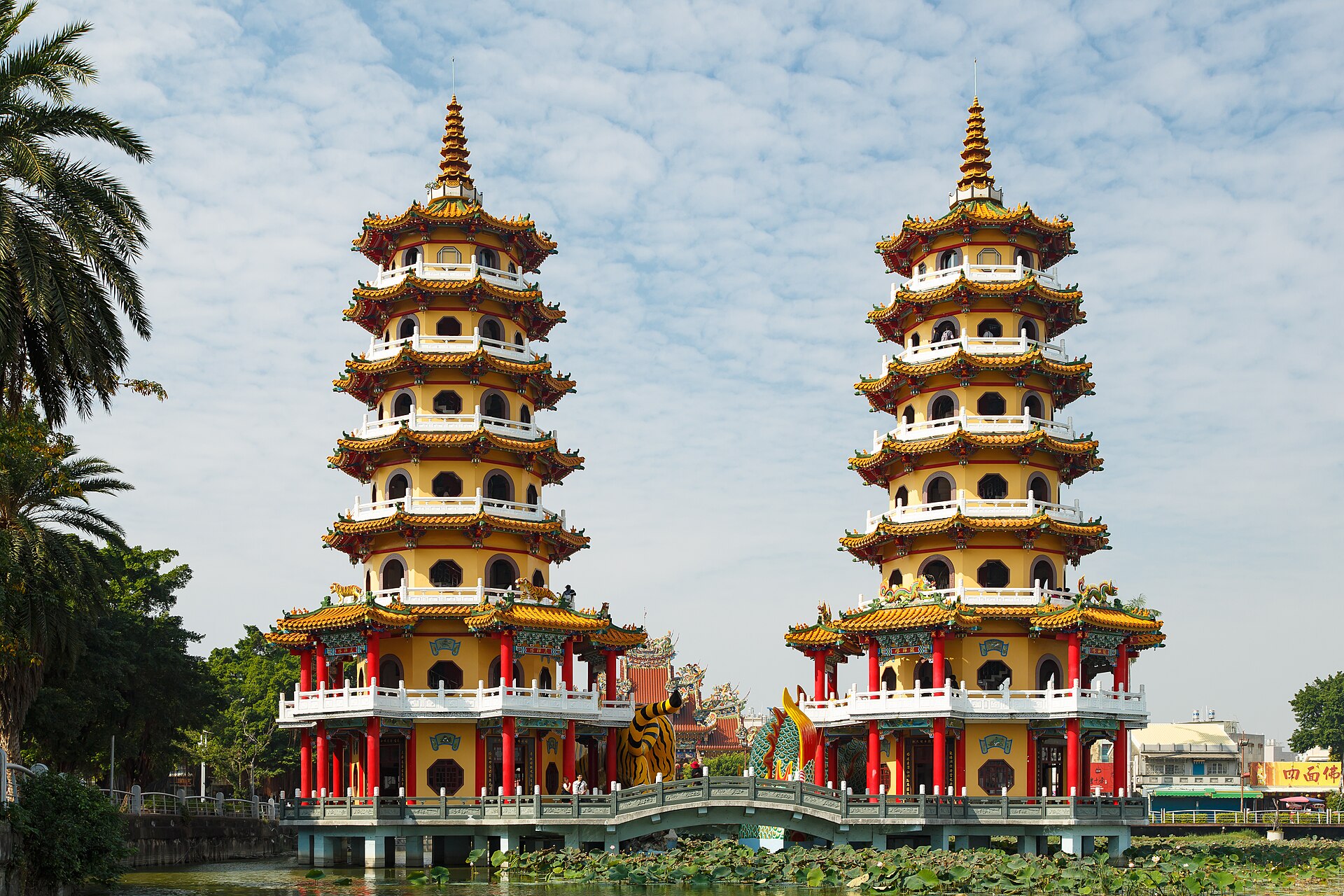
| Dragon and Tiger Pagodas | built 1976 by Zuoying Cideh Temple at Lotus Pond; seven floors each |
|---|---|
| How to walk them | cross the nine-turn bridge, enter through the dragon’s mouth and leave through the tiger’s mouth |
| Inside | the dragon pagoda has the Twenty-Four Filial Exemplars and Ten Courts of Hell paintings; the tiger pagoda has the 72 sages and 36 officer-generals |
| Early history | written records from the early 17th century, when the city was called Takao |
Taiwan – Getting to know Kaohsiung
Situated on the southwestern coast of the island, facing the Taiwan Strait, Kaohsiung City has grown from a small fishing village into Taiwan’s largest port. It is the country’s centre for heavy industries, and the political and economic heart of the south.
Taiwan Kaohsiung Travel Guide
Kaohsiung has a long history and although written records can only be traced back to the early 17th century when Kaohsiung was known as Takao, archaeological studies indicate that the Makatau clan of the Siraya Aboriginal tribe settled in the area prior to this. There is also evidence of human activity dating back to roughly 5,000 years ago; prehistoric artefacts including agricultural tools have been found in the hills surrounding the city.
Despite its industrial past, the city now has parks, cafes and cultural venues, plus beaches and forest close by. The Love River, which flows through the city to the harbour, is the city’s leisure hub, with the Love River Park providing cycling and walking paths, a night market and several outdoor cafés which are popular spots for live music. Tourist boats provide services up and down the river to gaze at the historic structures like the Kaohsiung Bridge, the District Court and the Holy Rosary Cathedral.
What to do at Kaohsiung
Kaohsiung is the main gateway to Fo Guang Shan Monastery, Taiwan’s largest Buddhist monastery, so many visitors just skip on through, but it’s well worth spending time in this multi-faceted city. Take in the exhibitions by local creative talents at Dadong Culture & Arts Centre and the Museum of Fine Arts, with its five floors of classical and modern art. Visit Meinong Folk Village to see and buy local handicrafts such as oil paper umbrellas and sample Hakka food.
The interesting structure of Kaohsiung Main Public Library and illuminating design of The Dome of Light at Formosa Boulevard Station should satisfy the design-minded; while cyclists can take to the many paths along the Love River and Park. Visit the Dragon and Tiger Pagodas at Lotus Lake and stop at Wuliting at dusk, a lookout pavilion on the lake for enchanting views of the city lights.
The unique design of the ‘Dome of Light’ on the concourse of the Formosa Boulevard MRT Station is one of the largest public glassworks of art in the world. It is a fine example of the local government’s commitment to promoting art and culture on the streets of Kaohsiung City.
Kaohsiung has nearly 1,500 temples – second highest after Tainan, and over 300 churches.
Getting off the trail in Kaohsiung
Learn more of the city’s history at Longquan Temple, where archaeologists have found well-preserved prehistoric ruins and artefects that suggest human settlement in the region thousands of years ago.
Learn about the ancient scholar system at Fengyi Academy and gain some insight into Taiwan’s modern history at the Martyr’s Shrine, originally built as Takao Kotohira Shrine during the Japanese rule.
To escape the city, take a trip to Caishan Natural Park, a mountain park just outside of Kaohsiung. Locals call it ‘Monkey Mountain’ after the many groups of endemic Formosan Rock Macaques that live and roam freely there. Several easy hiking trails will take you past playful families of macaques and a geological area with prehistoric corals that have been pushed up by tectonic activities. On reaching the top, soak up the remarkable views of the ocean and the city with the Dawu Mountain in the background.
Photo: CEphoto, Uwe Aranas, Wikimedia Commons, CC BY-SA 3.0. The Dragon and Tiger Pagodas at Lotus Pond.

Lotus Pond and the Dragon and Tiger Pagodas
The Dragon and Tiger Pagodas stand beside Lotus Pond in Zuoying. Zuoying Cideh Temple built them in 1976, and each has seven floors, a nod to the Buddhist saying about a seven-level pagoda. You reach them by a nine-turn bridge, and the custom is to enter through the dragon’s mouth and leave through the tiger’s mouth. Inside the dragon pagoda you see paintings of the Twenty-Four Filial Exemplars and the Ten Courts of Hell, with a statue of Ksitigarbha. The tiger pagoda has the 72 sages and 36 officer-generals and a shrine to Confucius. The double-spiral stair keeps people going up and down apart.
Sources (read in Chinese, Chinese Wikipedia): 龍虎塔. Last checked November 2026.
Kaohsiung: FAQ
What are the Dragon and Tiger Pagodas?
Two seven-floor pagodas at Lotus Pond in Zuoying, built in 1976 by Zuoying Cideh Temple.
How do you enter the Dragon and Tiger Pagodas?
Cross the nine-turn bridge, enter through the dragon’s mouth and leave through the tiger’s mouth.
Is Kaohsiung worth visiting?
Yes. It has the Love River, Lotus Pond, art museums and the Dome of Light, and it is the gateway to Fo Guang Shan Monastery.
How long do you need in Kaohsiung?
One full day covers Lotus Pond, the Love River and the Pier-2 area; add a day for Fo Guang Shan and Meinong.