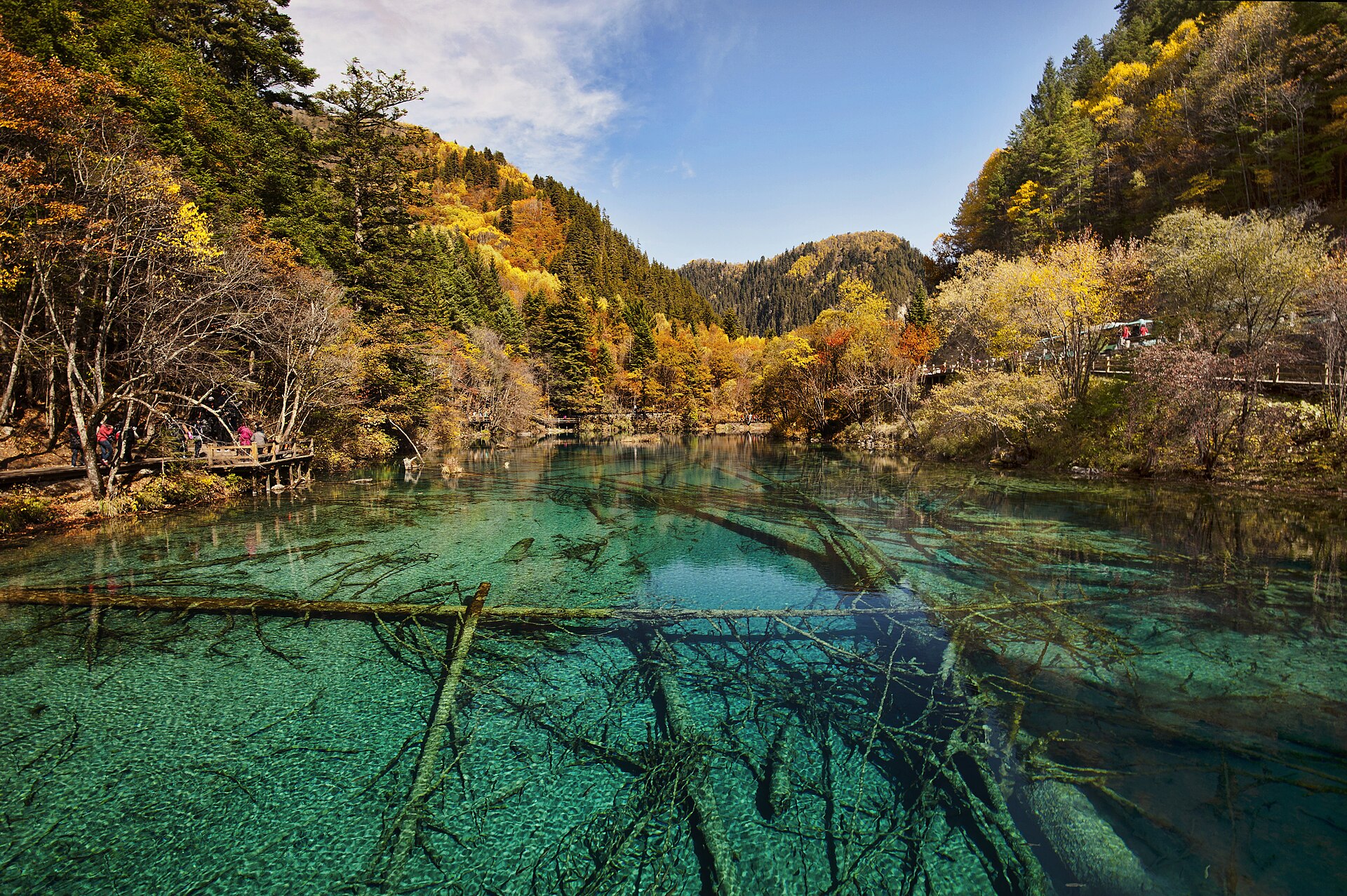
Jiuzhaigou is a nature reserve in the Min Mountains of northern Sichuan, in Jiuzhaigou County of the Aba Tibetan and Qiang Autonomous Prefecture. It is known for turquoise lakes, terraced waterfalls and autumn forest. UNESCO listed it as a World Natural Heritage Site in 1992, and nearby Huanglong, about 100 kilometers away, was listed the same year. The park was badly hit by an earthquake in August 2017, so check its current status before you plan a trip.
| Size and height | about 620 km²; 2,000 to 3,106 m; about 52% primeval forest |
|---|---|
| Layout | three valleys in a Y shape: Rize, Zechawa and Shuzheng |
| Name | from nine Tibetan villages in the valley |
| World Heritage | listed 1992; rated 5A in 2007 |
| 2017 earthquake | 8 August 2017; the park closed on 9 August |
| Reopening | to groups on 27 September 2019; to individuals from 28 November 2019; fully on 28 September 2021 |
| Entry rules | real-name tickets booked in advance, no on-site ticket window; daily visitor limits |
What the park is
Jiuzhaigou sits on the north slope of Mount Gaer in the southeast Tibetan Plateau and is called an alpine karst landscape. Most of its lakes, known locally as “seas” or haizi, were formed by calcium carbonate. When the climate warmed about 12,000 years ago, calcium carbonate in the water began to settle on obstacles and built the milky-white natural dams that hold the lakes back. The water looks clear and blue because the snowmelt is pure and passes through the stepped lakes. In winter all the lakes freeze except Five Flower Lake, where springs on the bed keep the water at about 6 degrees Celsius. The forest shelters giant pandas, golden monkeys and white-lipped deer. The Chinese name refers to the five wonders of the park: lakes, waterfalls, colored forest, snow mountains and Tibetan culture.
The 2017 earthquake and reopening
An earthquake struck late on 8 August 2017 and caused rockfalls at many sights. Nuorilang Waterfall collapsed badly, Double Dragon Lake and Reed Lake were largely washed away, and boardwalks near Rhinoceros Lake and Bonsai Shoal were damaged. Five Flower Lake lost much of its water, though no new barrier lakes formed. The park closed from 9 August 2017. It opened briefly to organized groups on 8 March 2018 with a limit of 2,000 a day, then closed again. It reopened on 27 September 2019, for groups only and with a limit of 5,000 a day, then to individual travelers from 28 November 2019 with a limit of 20,000. The whole park reopened on 28 September 2021 and the daily limit returned to about 40,000. Tickets and bus tickets must be booked online in advance with real names.
Staying and visiting
Since 2000 the park has followed a “visit inside, stay outside” policy, and the hotels inside closed on 1 May 2001, so you stay in the nearby town and enter by bus. The park has 40 viewing platforms and its main scenic areas include Shuzheng, Nuorilang, Sword Rock, Long Lake, Zharu and Tianhai. Autumn color, from about October, is the most popular season, and it is also the busiest.
Huanglong and onward travel
Huanglong, in Songpan County, is famous for its colored travertine pools in a valley about 7.5 kilometers long below the Snow Treasure Summit, and it lies above 3,000 meters. It is often paired with Jiuzhaigou on the same trip. The overland route continues north to Xiahe in Gansu, home to a major Tibetan Buddhist monastery. Many travelers fly from Chengdu. See also our China tours.
Planning Jiuzhaigou with Absolute Asia Tours
Absolute Asia Tours has planned private trips in Asia since 1989. For Jiuzhaigou that means checking the park’s current opening and ticket rules before we book, a driver or flight from Chengdu, and a guide who helps with advance booking. We’re rated 4.8 out of 5 across about 900 traveler reviews. See our China tours or tell us your dates.
Sources (read in Chinese, Chinese Wikipedia): 九寨沟, 黄龙风景名胜区. Last checked November 2026.
Jiuzhaigou: FAQ
Is Jiuzhaigou open?
Yes. After the August 2017 earthquake it reopened in stages and fully on 28 September 2021, with advance real-name tickets and daily limits. Check the current rules before you book.
Why is the water at Jiuzhaigou so blue?
The lakes are held back by calcium carbonate dams and fed by clear snowmelt, which passes through many stepped lakes.
Can you stay inside Jiuzhaigou?
No. Hotels inside the park closed on 1 May 2001, so you stay outside and enter each day.
How big is Jiuzhaigou?
About 620 square kilometers, from 2,000 to 3,106 meters in elevation.
How far is Huanglong from Jiuzhaigou?
About 100 kilometers. Both were listed as World Natural Heritage Sites in 1992.
Photo: Chensiyuan, Wikimedia Commons, CC BY-SA 4.0. Five Flower Lake, photographed in 2011 before the 2017 earthquake.
