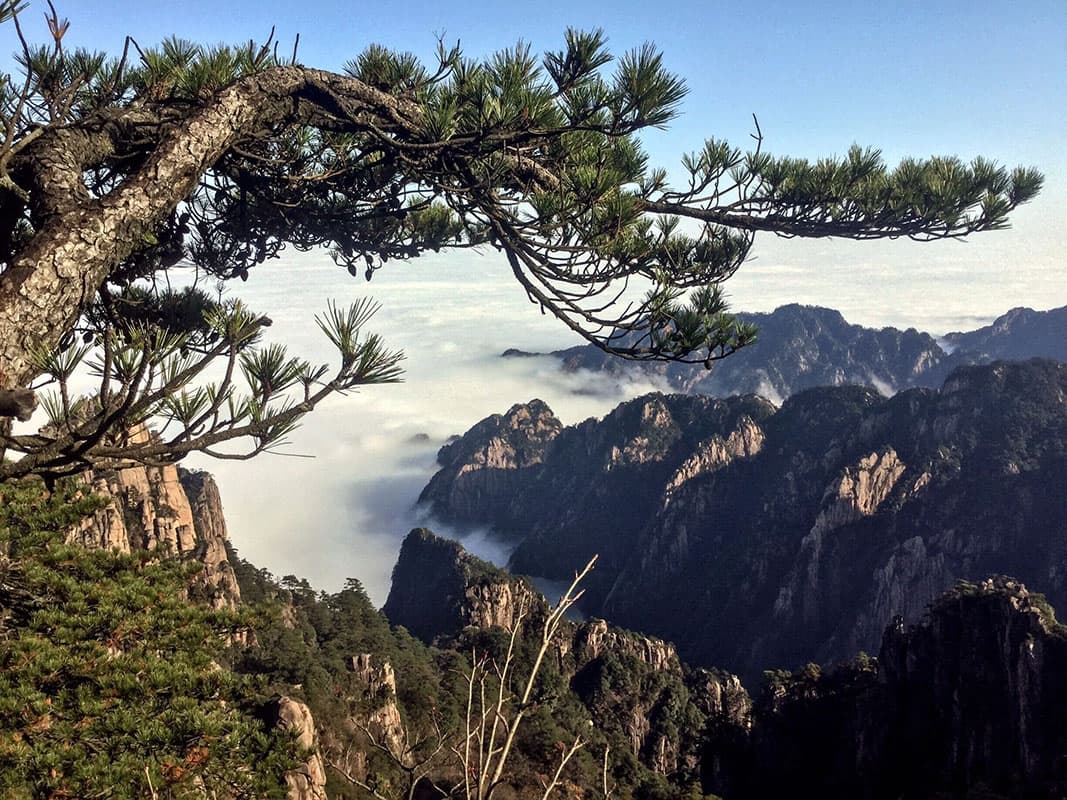
Huang Shan, the Yellow Mountains, is a granite range in southern Anhui Province, known for jagged peaks, twisted pines and a sea of clouds. UNESCO listed it as a mixed cultural and natural World Heritage Site in December 1990. Most visitors stay one night on the mountain or at its foot, and combine it with Hangzhou or the Anhui villages.
| Size | range about 1,200 km²; core scenic area about 160.6 km²; about 40 km north to south and 30 km east to west |
|---|---|
| Highest peak | Lotus Peak, 1,864.8 m |
| Name | formerly Yishan; renamed Huangshan in 747, in the Tang dynasty |
| World Heritage | December 1990, cultural and natural; Global Geopark since 2004 |
| Rock | mainly granite |
The mountain
The mountain was once called Yishan for its dark-blue peaks. According to tradition the Yellow Emperor made his elixir here, and the Tang emperor Xuanzong, a believer in Daoism, renamed it Huangshan in 747. The Ming traveler Xu Xiake climbed it twice and is credited with the saying that after seeing the five great mountains one need not see other mountains, and after Huangshan one need not see the five. Since 1982 it has been a national key scenic area, and it was listed in 1990 as a mixed site. The 2004 geopark listing and a 2015 IUCN Green List listing followed. Huang Shan is also linked in popular accounts with the setting of the film Avatar, alongside Guilin and Zhangjiajie.
Art and culture
Huang Shan is called the cradle of Chinese landscape painting. The Huangshan school of painting formed at the end of the Ming and start of the Qing, with the painters Mei Qing, Shi Tao and Jian Jiang as its three leading figures, and Shi Tao was the first to paint all 72 peaks. Poets including Li Bai wrote about it. Pine soot from Huang Shan has been used to make Hui ink since the Southern Tang. The largest cliff inscription, on Qingluan Peak, has characters six meters square.
Planning
Climbing routes and cable cars start at the foot of the mountain, and the summit area has hotels where you can see sunrise. Weather decides what you see: clouds are common and views change from hour to hour. Spring, from April, and autumn are the usual seasons. Allow two days. The mountain links with Hangzhou and Shanghai. See also our China tours.
Planning Huang Shan with Absolute Asia Tours
Absolute Asia Tours has planned private trips in Asia since 1989. For Huang Shan that means a hotel on the summit or at the base, a guide for the routes, and a back-up plan for poor weather. We’re rated 4.8 out of 5 across about 900 traveler reviews. See our China tours or tell us your dates.
Sources (read in Chinese, Chinese Wikipedia): 黄山. Last checked November 2026.
Huang Shan: FAQ
How high is Huang Shan?
The highest peak, Lotus Peak, is 1,864.8 meters.
When was Huang Shan listed by UNESCO?
In December 1990, as a mixed cultural and natural site.
Why is it called the Yellow Mountains?
It was renamed in 747 under the Tang emperor Xuanzong, after the tradition that the Yellow Emperor made his elixir there.
Who were the Huangshan school painters?
Mei Qing, Shi Tao and Jian Jiang are the three leading figures of the school.
How many days do you need at Huang Shan?
Two days, with a night on or at the foot of the mountain.