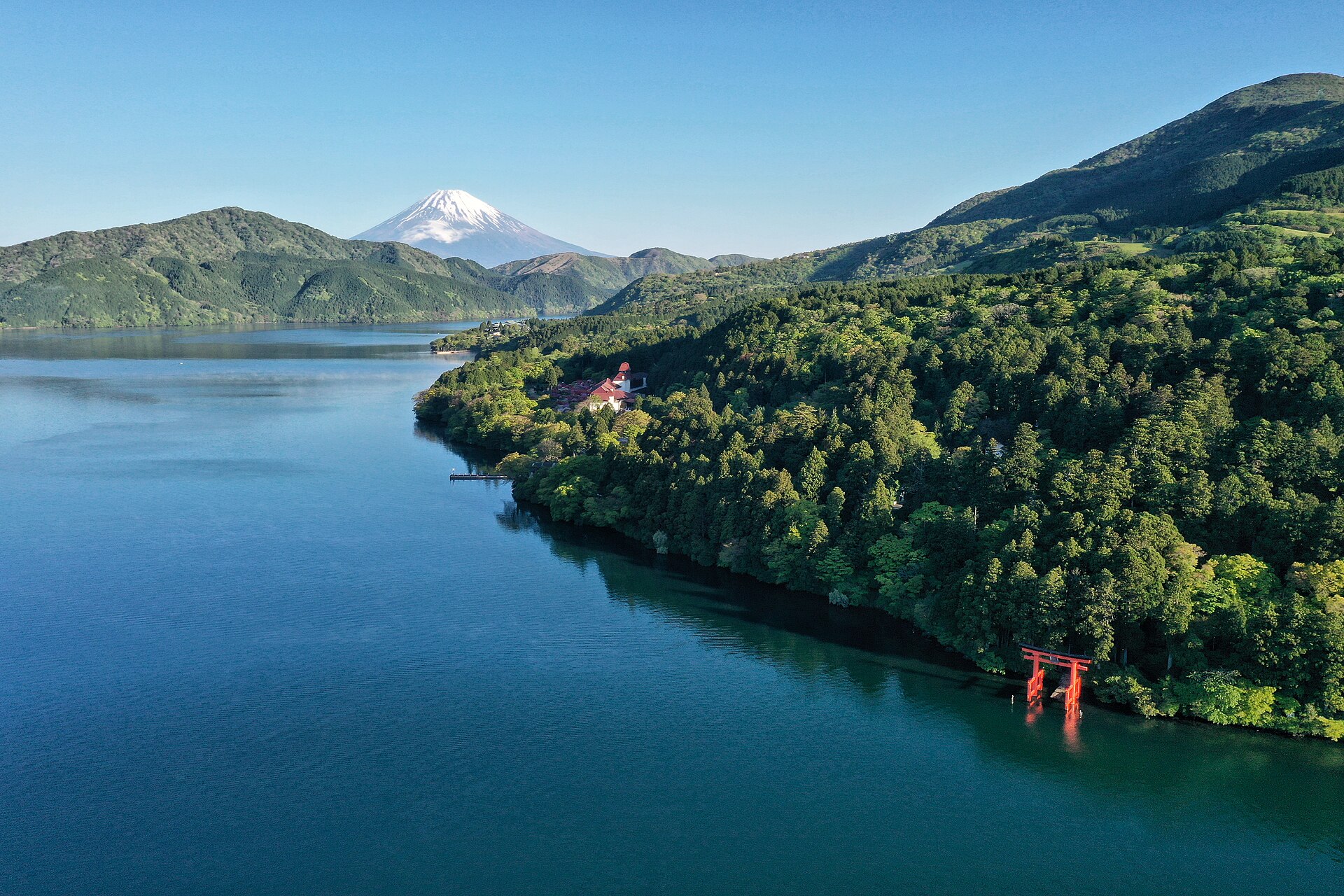
Hakone is a hot-spring town in the mountains southwest of Tokyo, built around a volcanic caldera and a lake. It has been a resort for a long time, and on a clear day you can see Mount Fuji from the lakeshore. It’s one of the easiest overnight trips from the capital, and a classic way to try a ryokan.
| Lake Ashi | caldera lake formed about 3,100 years ago, largest in Kanagawa |
|---|---|
| Hakone Shrine | founded 757 |
| Edo-period checkpoint | 1619 to 1869, on the Tokaido |
| Owakudani | fumarole valley at 800 to 1,000 m; access can be restricted |
| Open-Air Museum | opened 6 September 1969, Japan’s first |
| From Tokyo | Odakyu Romancecar, Shinjuku to Hakone-Yumoto, under two hours |
| Day trip timing | about 8:30 am to 6:30 pm (official Hakone site) |
A hot-spring town
Hakone lies in the west of Kanagawa Prefecture, east of Hakone Pass. The name Hakone covers a group of hot-spring areas, including Yumoto, Tonosawa, Ohiradai, Miyanoshita and Kowakudani. In the Edo period a checkpoint stood here on the Tokaido highway, and the town was already well known for its baths. After the war, rival railway and bus groups competed to develop it, and it grew into one of Japan’s best-known onsen destinations. Every 2 and 3 January it’s also the turning point of the Tokyo-Hakone university relay race, a New Year tradition.
Lake Ashi
Lake Ashi is a caldera lake and the largest lake in Kanagawa. It formed about 3,100 years ago, when a steam explosion and pyroclastic flow collapsed part of Mount Kamiyama and dammed the Haya River. Hakone Shrine, on the shore, was founded in 757, and its red torii stands in the water. Sightseeing boats have run on the lake since 1911, and the pirate-ship boats since 1950. The lake doesn’t freeze in winter, which keeps the climate around it milder than other lakes at the same height. On a clear day Mount Fuji is visible from the shore.
Owakudani
Owakudani is a steaming valley on the slopes of Mount Kamuriga, between 800 and 1,000 meters, and the largest of Hakone’s fumarole areas. It formed after the same eruption that made the lake, and it also supplies hot spring water to many hotels in the area. Because of volcanic gas, the authorities run an alarm system with announcements in four languages, and Japanese records note changes in the fumaroles and seismic activity in 2013 and 2015. Access to the area can be restricted at short notice, so check before you plan it.
The Edo-period checkpoint
From 1619 to 1869, the Tokugawa shogunate kept a checkpoint on the Tokaido highway by the shore of Lake Ashi, to control who traveled to and from Edo. A reconstruction now stands near the water.
The mountain railway and the Open-Air Museum
The Hakone Tozan Railway, now part of Odakyu Hakone, runs up the mountain from Odawara, and the company also operates a cable car, the Hakone Ropeway and the lake boats, so you can make a loop of the sights. The Hakone Open-Air Museum, which opened on 6 September 1969, is Japan’s first open-air museum. Its sculpture garden covers about 70,000 square meters and has a Picasso Pavilion, which was renewed in 2019.
Weather and when to go
Hakone is rainy overall because of the mountains. The weather is mild at Hakone-Yumoto, but it gets colder as you climb, and Sengokuhara, at about 700 meters, can be cold. Pack for changeable weather, and keep an eye on the sky if you want a view of Mount Fuji.
Hakone day trip from Tokyo: the Hakone Loop
You can see the main sights of Hakone in a day. The official Hakone tourism site recommends starting about 8:30 am from Tokyo and being back around 6:30 pm, with the classic circuit known as the Hakone Loop. The loop links the town and the lake by mountain railway, cable car, ropeway, boat and bus. The official site says you can go clockwise or counter-clockwise, and that counter-clockwise is less crowded while still reaching the same places.
| Day trip | Overnight | |
|---|---|---|
| Time | About 8:30 am to 6:30 pm, per the official Hakone site | Two days, which splits the loop in half |
| What you see | Hakone Shrine, Lake Ashi, Owakudani, plus Moto-Hakone, Yumoto and Gora | The same, plus a ryokan with a hot spring, and a museum or short hike |
| Best for | Fitting Hakone into a longer Japan route | Seeing it at a comfortable pace |
Getting there and the Freepass
The Odakyu Romancecar runs from Shinjuku Station straight to Hakone-Yumoto Station without a change. The trip takes under two hours: Odakyu’s own guide describes a 7:37 am train arriving at 9:22 am. All Romancecar seats are reserved, and the ticket costs extra on top of any pass. The Hakone Freepass covers the trains, cable car, ropeway, boats and buses within Hakone, and it’s sold digitally through EMot, Odakyu’s official ticket site. Between Shinjuku and Odawara, it covers one outbound and one return trip on regular trains only.
Odakyu listed these prices in March 2026: the 2-day Freepass was 7,100 yen for adults and 1,600 yen for children aged 6 to 11, the 3-day pass was 7,500 yen for adults and 1,850 yen for children, and the Romancecar was 1,150 yen per trip. Fares change, so confirm them on the official site before you buy.
A day on the loop
- Hakone-Yumoto. Arrive by Romancecar and change to the Hakone Tozan Railway.
- Mountain railway and cable car. Ride up to Gora, then take the cable car and the Hakone Ropeway.
- Owakudani. The ropeway passes over the steaming valley. The area is known for black-shelled eggs boiled in the hot springs. Check that Owakudani is open that day.
- Lake Ashi. Take the sightseeing cruise across the lake and look for Mount Fuji.
- Hakone Shrine and the old highway. Walk to the shrine and its torii, then along the Old Tokaido Road and its cedar avenue.
- A day-use hot spring. Some public baths in Hakone take day visitors, which is a way to end the day without an overnight stay.
If you stay two nights, the official site notes that where you stay changes how you explore: Gora is central, Yumoto is close to transport, Miyanoshita has a historic feel, Sengokuhara is near Mount Fuji views, and Moto-Hakone is by the quiet lake.
How long to stay
An overnight stay works best, with a ryokan and its hot spring in the evening. See our guides to Mount Fuji, Nikko, Japan honeymoon and Tokyo, and our Japan tour packages.
Planning Hakone with Absolute Asia Tours
Absolute Asia Tours has planned private trips in Asia since 1989. For Hakone that means a ryokan with a private bath, a transfer from Tokyo, a loop through the sights timed to the weather, and a fallback if Owakudani is closed. We’re rated 4.8 out of 5 across about 900 traveler reviews. Have a look at our Japan tours or tell us your dates.
Sources (read in Japanese, Japanese Wikipedia): 箱根町, 芦ノ湖, 大涌谷, 箱根 彫刻の森美術館, 箱根神社. Day-trip logistics: Hakone Japan (official tourism site) and Odakyu Railway, Hakone 1-day trip guide (12 March 2026). Last checked November 2026.
Hakone: FAQ
How long does it take to get from Tokyo to Hakone?
Under two hours. The Odakyu Romancecar runs from Shinjuku to Hakone-Yumoto without a change.
Is a day trip to Hakone from Tokyo enough?
Yes for the highlights. The official Hakone site suggests leaving about 8:30 am and returning about 6:30 pm, and says an overnight stay lets you see more.
What is the Hakone Freepass?
A pass for the trains, cable car, ropeway, boats and buses within Hakone, sold digitally through EMot. In March 2026 the 2-day adult pass was listed at 7,100 yen; check the current price.
Should you do the Hakone Loop clockwise or counter-clockwise?
Either works. The official site says counter-clockwise is less crowded and reaches the same sights.
How was Lake Ashi formed?
About 3,100 years ago a steam explosion and pyroclastic flow collapsed part of Mount Kamiyama and dammed the Haya River.
Can you see Mount Fuji from Hakone?
Yes, from the area around Lake Ashi on a clear day.
What is Owakudani?
A volcanic valley of steam vents on the slopes of Mount Kamuriga. Access can be restricted because of volcanic gas, so check first.
What was the Hakone checkpoint?
A checkpoint on the Tokaido highway by Lake Ashi, kept by the Edo shogunate from 1619 to 1869.
What is the Hakone Open-Air Museum?
Japan’s first open-air museum, opened on 6 September 1969.
Photo: Charlie fong, Wikimedia Commons, CC BY-SA 4.0.
