| Status | historically Tibet’s third city, after Lhasa and Shigatse; national historic and cultural city since 1994 |
|---|---|
| Pelkor Chode (Palcho) Monastery | built 1418 to 1425; Sakya, Shalu and Gelug traditions in one monastery; national protected site since 1998 |
| Gyantse Dzong | fortress where Tibetan defenders resisted British forces in 1904; national protected site |
| County population | 68,650 (2020) |
| Local products | barley, peas, wheat, rapeseed; Tibetan carpets woven here for about 1,200 years |
| Nickname | ‘granary of rear Tsang’ |
Tibet – Getting to know Gyantse
Gyantse is often treated as little more than a stopover destination en route from Lhasa to Shigatse. This unassuming, laidback mountain town retains a pleasantly authentic Tibetan ambience, and is also home to the Palcho Monastery and its towering Kumbum (Pelkor Chode), an ancient site that many consider to be one of the most spectacular architectural achievements on the Tibetan Plateau.
Tibet – Gyantse Travel Guide
Set in the Nyang Chu valley, Gyantse sits at the convergence of several ancient trade and pilgrimage routes between India, Nepal, Bhutan and Lhasa. In centuries past it was among the largest urban settlements in Tibet, but the town suffered terribly in the British invasion in 1903/4, and then again half a century later during the Chinese Cultural Revolution, which saw hundreds of monks and local artisans either imprisoned or driven into exile.
The road from Lhasa crosses the Kamba-La Pass, with views of Yamdrok Tso Lake; allow a long day for the drive. In contrast to many other Tibetan towns, Gyantse has largely escaped the worst excesses of Chinese development, and its dusty streets, particularly in the old town around the monastery complex, are a joy to explore at a relaxed pace.
The town’s full beauty can best be appreciated from above, and the foreboding Gyantse Dzong offers several excellent viewpoints from its hilltop advantage. Small whitewashed houses cluster around the Palcho Monastery, surrounded by a protective wall, and in the background, the mountainous, lunar-like plateau that stretches out seemingly forever.
What to do in Gyantse
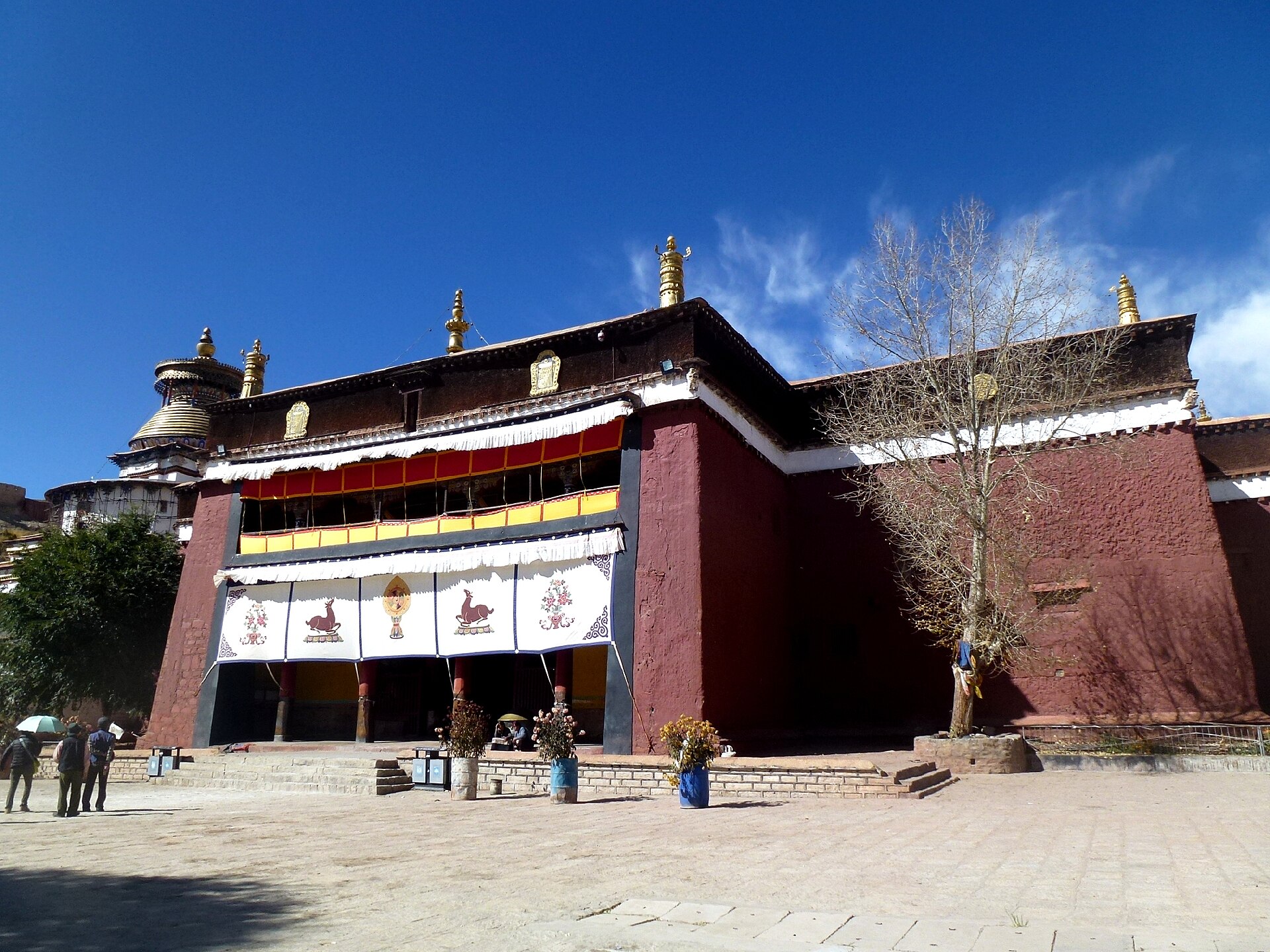
Situated on the west of town, the Palcho Monastery is a vast complex of religious structures, and the main event in Gyantse. Unusually, three different schools of Tibetan Buddhism (Gelugpa, Sagyapa and Kadampa) coexist peacefully under one roof here, while the architecture is a fascinating mix of Tibetan, Han Chinese and Nepali craftsmanship. The monastery’s ample treasures include over 1,000 sets of ancient Tibetan sutras (for the purpose of studying religion and ethnic cultures), intricate sculptures and carvings, and a hugely influential set of murals depicting historic figures and stories from Buddhism. Wandering around, you may see the occasional bullet hole in the masonry, too – a sobering reminder of the British assault in 1904.
The focal point of the monastery is the frankly incredible Kumbum. The tower comprises 76 individual chapels over nine tiers, stretching 32 metres into the sky and topped with a golden dome that sparkles brilliantly in the sunlight. Probably the largest, and certainly the most important of its kind in the country, the Kumbum contains some 100,000 depictions of the Buddha – which, of course, is why it’s known as the ‘Ten Thousand Buddhas Pagodas’.
What to do around Gyantse
Overlooking the town from a clifftop, the Gyantse Dzong is a well-preserved fortress, originally built in the 9th century, and restored in recent years. Gyantse is referred to as ‘The Hero City’ by the Chinese, for the spirited resistance that the inhabitants put up against overwhelming odds when British troops led by Sir Francis Younghusband attacked in 1904. Some 3,000 Tibetans died in minutes under British machine gun fire, with the survivors putting up a futile but brave resistance at the dzong, which was badly damaged. That vivid story of patriotism, and a Chinese perspective on the ignoble excesses of the British, is explored at an interesting on-site museum. The brisk climb up is worth it for the views alone.
Just a 10 minute drive out of town, the Pala Manor is a large estate of around 60 houses that showcases the lifestyles of 19th century wealthy landowners. The main house has several reception rooms, one of which was reserved for playing mahjong on a set carved from ivory. Exhibits include an ox horn that would have been filled with barley wine, delicate porcelain bowls for drinking ghee, and even cases of whisky brought over from Britain. Visitors can make an Upstairs-Downstairs comparison between the privileged lives of Tibetan nobility, and the disadvantaged circumstances of their serfs – the estate also had its own prison.
select another destination
Legend has it that in ancient times, when the Lord of Gyantse wanted to demonstrate his wealth and power, he sent a craftsman over to Lhasa to study the Potala Palace with the aim of replicating the design. For reasons unknown, perhaps he’d lost his sketchbook, the architect chose to make his notes on a radish! By the time he returned to Gyantse, the vegetable had frustratingly shrunk, which is why, if you squint a bit, the Gyantse Dzong (apparently) looks like a version of the Potala Palace, only in miniature!
Weaving an ancient tradition
Gyantse is renowned for the quality of its traditional woollen rugs – they have been woven here by hand for over 900 years. Featuring bold, colourful designs that can be seen brightening up the floors and walls of many Tibetan homes, the rugs are still produced today, albeit using slightly more modern techniques.
The Pelkor Chode monastery
Pelkor Chode, called Baiju Temple in Chinese, was begun in 1418 by the local ruler Rabten Kunsang Phagpa with the scholar Khedrup Je, the first Panchen Lama, and finished in 1425. It is a three-story flat-roofed building laid out as a mandala, and it contains halls, a main assembly hall and a multi-door stupa. It is unusual in that monastic colleges of the Sakya, Shalu and Gelug schools lived in one monastery. The 1904 fighting ended with British forces taking the dzong and then the monastery. It became a national protected site in 1998. Repairs funded by the state in 1977 reopened part of it in December 1979.
The dzong and the town
The name Gyantse comes from the Tibetan “Gyelkartse”, meaning a supreme palace, applied to the fortress on the hill. In 1904 defenders built gun positions on the slope to resist the British expedition, but they were overwhelmed by a far stronger force. The town is the center of an agricultural area known as the granary of rear Tsang, and carpet weaving has a long tradition. Gyantse is on the route between Lhasa and Shigatse, so most itineraries combine it with the Yamdrok Lake road.
Sources (read in Chinese, Chinese Wikipedia): 江孜县, 白居寺. Last checked November 2026.
Gyantse: FAQ
What is the Gyantse Kumbum?
A multi-door stupa within Pelkor Chode Monastery, built in the 15th century.
When was Pelkor Chode built?
From 1418 to 1425.
What happened at Gyantse in 1904?
Tibetan defenders at the dzong resisted a British expedition and were defeated; the British then took the monastery.
Which schools share Pelkor Chode?
The Sakya, Shalu and Gelug traditions.
Is Gyantse a historic city?
Yes. It has been a national historic and cultural city since 1994.
Photo: Hiroki Ogawa, Wikimedia Commons, CC BY 3.0. Pelkor Chode Monastery, Gyantse.
