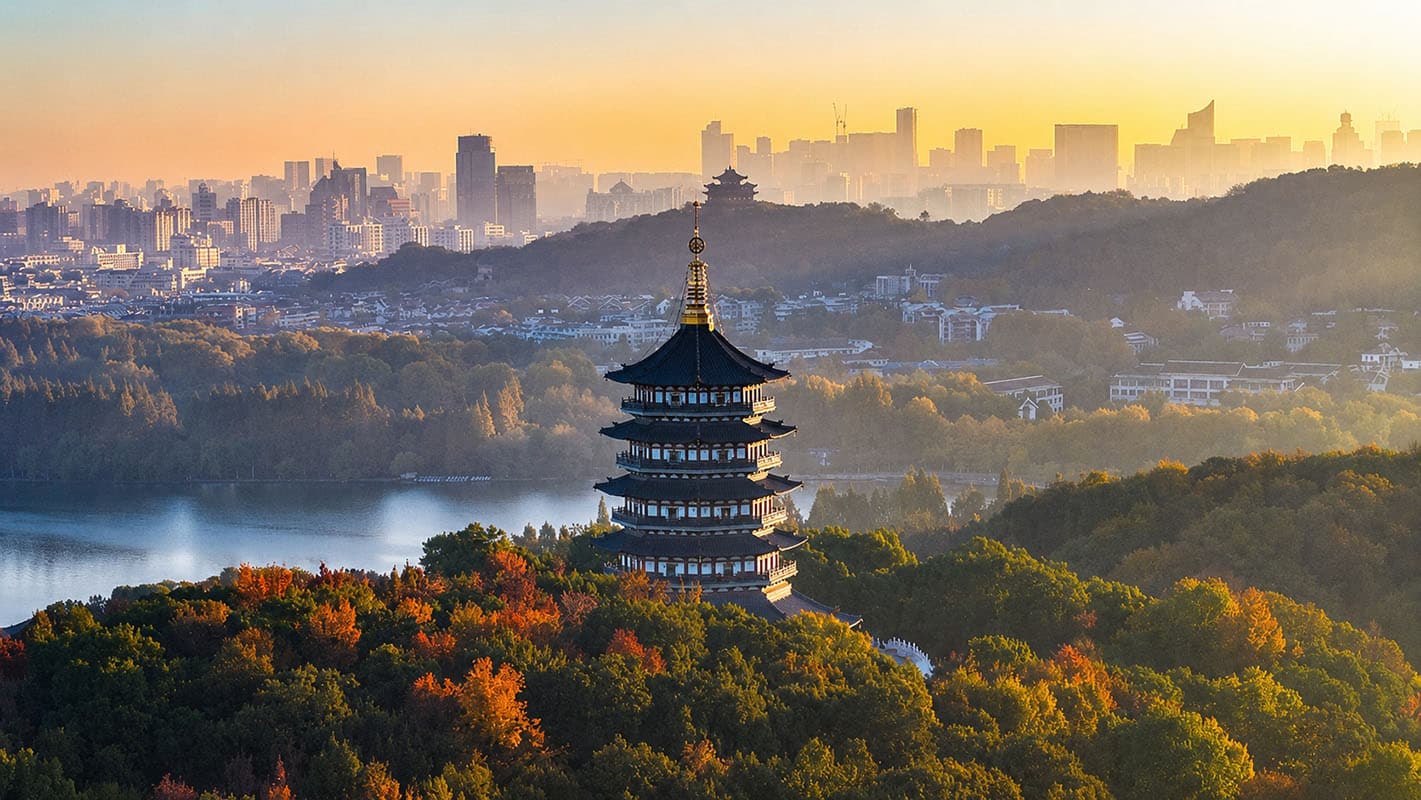
Hangzhou, the capital of Zhejiang Province, is known for West Lake, a UNESCO cultural landscape in the old city’s west, and for Longjing green tea from the hills near the city. It is a short high-speed train ride from Shanghai, so it fits an overnight stop between Shanghai and Suzhou or Huang Shan.
| West Lake | about 6.39 km²; about 15 km around; average depth 2.27 m; World Heritage Site since 24 June 2011 |
|---|---|
| Layout | “one hill, two pagodas, three islets, four causeways, five lakes” |
| Lingyin Temple | founded 326 by the Indian monk Huili; one of China’s ten great ancient temples |
| Leifeng Pagoda | built 972 to 977 by Qian Chu; fell 25 September 1924; rebuilt October 2002 |
| Ratings | West Lake was a 5A scenic area in 2006, among China’s top ten scenic places from 1985 |
West Lake
West Lake is bordered by the city on the east and hills on the other three sides. It measures about 3.2 kilometers north to south and 2.8 east to west, and Solitary Hill is the largest natural island. The Bai and Su causeways cross it, and three artificial islets stand in the outer lake. Leifeng and Baochu pagodas face each other across the water, which gives the lake its layout. The name West Lake first appears in poems by Bai Juyi, and Su Shi was the first to use it in an official document. The Three Pools Mirroring the Moon scene appears on the back of the 1-yuan note issued in 2004. Walking the whole shore takes most of a day, and bicycles and boats are common.
Lingyin Temple
Lingyin Temple lies in the hills northwest of the lake, between Feilai Peak and North Peak. The monk Huili founded it in 326 and took the setting for a place where immortals hide, which is the meaning of the name. In the Five Dynasties it reached nine towers, eighteen pavilions and 77 halls, with 3,000 monks. The Taiping army burned it in 1860, leaving only the Hall of Heavenly Kings and the Arhat Hall, and the main hall was rebuilt and finished by 1910. On Zhou Enlai’s instruction it escaped destruction in 1966. The rock carvings of Buddhas on Feilai Peak are on the way to the gate.
Leifeng Pagoda
Qian Chu, king of Wuyue, had the original built from about 972 to 977 to hold a relic. It was a seven-story brick-and-timber pagoda. Japanese pirates burned its wooden eaves in the Ming, and people later dug out bricks for good-luck uses until the pagoda collapsed on 25 September 1924. A new pagoda covering the old foundation opened in October 2002. It is known from the folk tale of the White Snake, and the sunset view is one of West Lake’s ten scenes.
Longjing tea and planning
Longjing is a green tea from the hills near the city, and a visit to a tea village is a common half-day. Allow two days: one for the lake, Leifeng and the old streets, and one for Lingyin and the tea hills. Spring and autumn are the most comfortable. Hangzhou links with Shanghai, Suzhou and Huang Shan. See also our China tours.
Planning Hangzhou with Absolute Asia Tours
Absolute Asia Tours has planned private trips in Asia since 1989. For Hangzhou that means a lakeside hotel, a driver for Lingyin and the tea villages, and a guide who explains the lake’s layout. We’re rated 4.8 out of 5 across about 900 traveler reviews. See our China tours or tell us your dates.
Sources (read in Chinese, Chinese Wikipedia): 西湖, 灵隐寺, 雷峰塔. Last checked November 2026.
Hangzhou: FAQ
How big is West Lake?
About 6.39 square kilometers, with a shore of about 15 kilometers and an average depth of 2.27 meters.
When did West Lake become a World Heritage Site?
On 24 June 2011.
When was Lingyin Temple founded?
In 326, by the Indian monk Huili.
Is Leifeng Pagoda original?
No. The original fell in 1924 and the present pagoda was completed in October 2002.
How many days do you need in Hangzhou?
Two days for the lake, Lingyin and the tea hills.