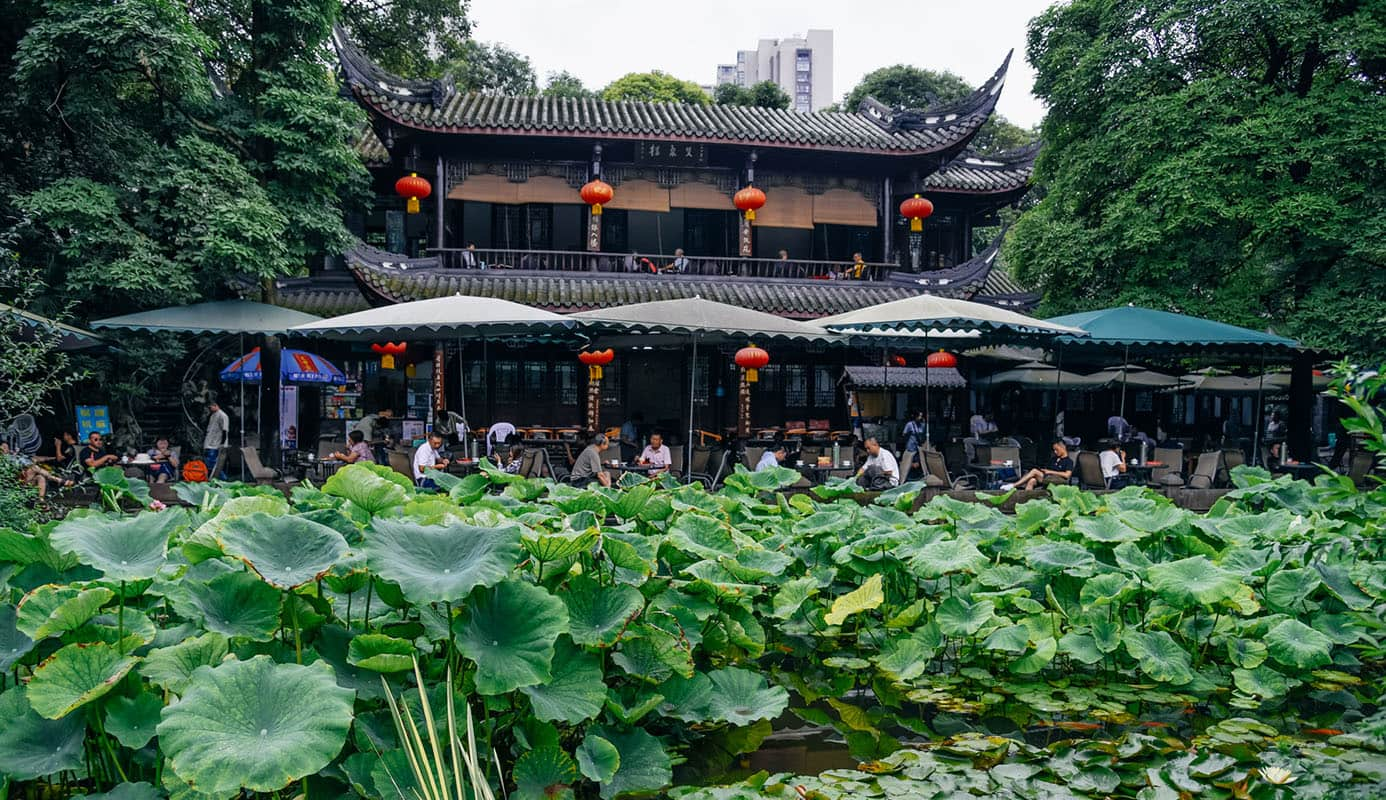
Chengdu is the capital of Sichuan Province, in the Chengdu Plain in the west of the Sichuan Basin. It is best known for giant pandas, Sichuan cuisine and teahouses, and it is the usual base for the Leshan Giant Buddha and the Dujiangyan irrigation system. About 21.4 million people lived in the city in 2023.
| City history | about 3,200 years, from the Jinsha site; walls built in 311 BC; capital of nine regimes |
|---|---|
| Food | UNESCO City of Gastronomy since 2010, the first in Asia |
| Panda Base | opened 1987 with six rescued pandas; 260 giant pandas by the end of 2024; area grew from 1,035 to 3,570 mu in January 2022 |
| Dujiangyan | begun about 256 to 251 BC under Li Bing; World Heritage Site since 2000 with Mount Qingcheng |
| Leshan Giant Buddha | carved 713 to 803, about 90 years; World Heritage Site since 1996 with Mount Emei |
Giant pandas
The Chengdu Research Base of Giant Panda Breeding is a research and conservation center in the Chenghua district on the northern edge of the city. It was founded after the bamboo die-off of 1983 in the pandas’ mountain home, which led to rescues. The base opened in 1987, and its first group was six pandas taken from the wild. By the end of 2024 it had 260 giant pandas, and at the end of 2025 it housed 201 red pandas. An expansion opened in trial operation on 1 January 2022. A second site, the Dujiangyan base, lies in Dujiangyan. Pandas are generally most active in the morning, so many visitors go early.
Dujiangyan
Dujiangyan is an irrigation system on the Min River about 340 kilometers from its source. Records say it was begun by Li Bing, governor of Shu for the Qin state, and his son, in about 256 to 251 BC. It has three main works: the Fish Mouth that divides the river, the Flying Sand Weir that spills floodwater and silt, and the Baoping Channel that brings water in. In spring about 60% of the flow goes to the inner channel for planting, and in the flood season about 60% goes to the outer river, the “four-six split.” Its irrigation made the Chengdu Plain the “land of abundance.” UNESCO listed it with Mount Qingcheng in 2000.
Leshan Giant Buddha
The Leshan Giant Buddha sits where the Min, Qingyi and Dadu rivers meet and is described as the tallest stone Buddha in the world. A monk named Haitong began it in the early eighth century, with the first date given as 713, to calm the dangerous water at the confluence. Work stopped twice and was completed in 803, about 90 years later. The statue has been repaired many times. It is a national protected site, and it was listed in 1996 together with Mount Emei. A boat on the river gives the best view from below.
Food and city sights
UNESCO named Chengdu a City of Gastronomy in 2010. The city’s other sights include the Wuhou Shrine, Du Fu Thatched Cottage and the Jinsha site, which supports its 3,200-year history. Teahouses such as the one in People’s Park are a normal part of daily life here. Hotpot and Sichuan peppercorn are the flavors most visitors ask for.
Planning Chengdu
Two days covers the city and the pandas, and a third day adds Dujiangyan or Leshan. Spring and autumn are comfortable. From Chengdu, many travelers fly to Jiuzhaigou, Lhasa or Chongqing. See also our China tours.
Planning Chengdu with Absolute Asia Tours
Absolute Asia Tours has planned private trips in Asia since 1989. For Chengdu that means a morning at the panda base timed for the animals’ active hours, a driver for Dujiangyan or Leshan, and restaurant bookings. We’re rated 4.8 out of 5 across about 900 traveler reviews. See our China tours or tell us your dates.
Sources (read in Chinese, Chinese Wikipedia): 成都市, 成都大熊猫繁育研究基地, 都江堰, 乐山大佛. Last checked November 2026.
Chengdu: FAQ
What is Chengdu known for?
Giant pandas, Sichuan food, teahouses and day trips to Dujiangyan and the Leshan Giant Buddha.
How many pandas are at the Chengdu Panda Base?
260 giant pandas by the end of 2024, according to Chinese Wikipedia.
How old is the Dujiangyan irrigation system?
It was begun about 256 to 251 BC and still works today.
How long did the Leshan Giant Buddha take to carve?
About 90 years, from 713 to 803.
How many days do you need in Chengdu?
Two days for the city and pandas, and a third for Dujiangyan or Leshan.