Macau is a small peninsula and two islands on the south coast of China, and it was a Portuguese trading port for more than four centuries. The casino resorts get the headlines, but the old city is the part that deserves a visit: churches, forts, tiled squares and Chinese temples sit in the same few streets. It’s an easy day or overnight trip from Hong Kong or Zhuhai.
| UNESCO | Historic Centre, 15 July 2005 |
|---|---|
| Heritage area | 22 buildings and 8 squares |
| Portuguese rule | mid-16th century to 1999 |
| St. Paul’s College | founded 1594 |
| Facade | completed 1637 to 1640; fire 1835 |
The Historic Centre of Macau
Macau became a Portuguese settlement in the mid-16th century and returned to China in 1999. UNESCO listed its Historic Centre on 15 July 2005, the 31st World Heritage Site in China. It covers 22 buildings and 8 adjoining squares on the peninsula. UNESCO described it as the earliest and most lasting meeting of China and the West, and it kept the layout of a European port town: small squares joined by narrow, winding streets. The first Western-style theater, university, hospital, church and fort in China were built here, and some of them are still in use.
Ruins of St. Paul’s
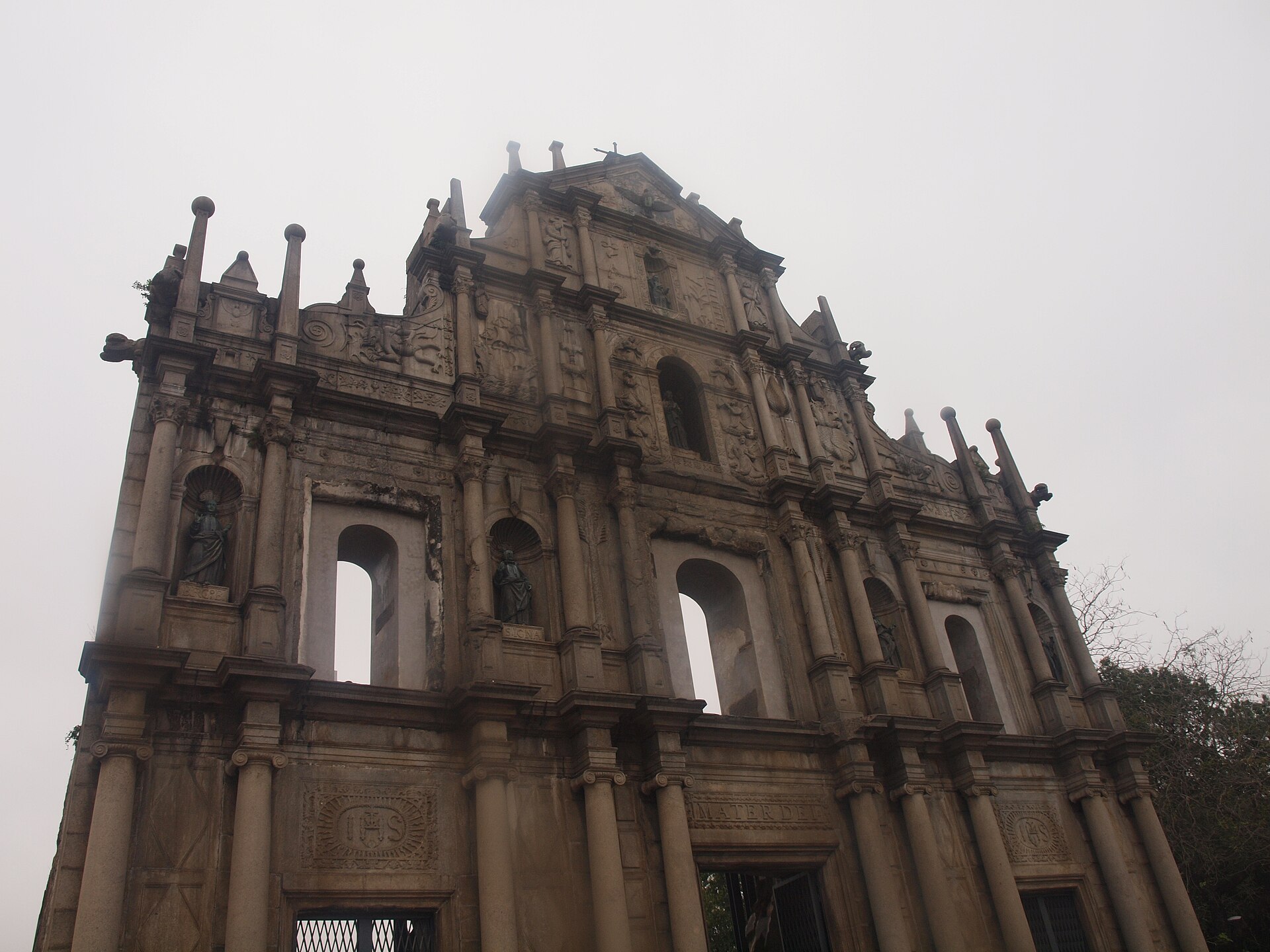
The granite facade of St. Paul’s is Macau’s best-known landmark. The church belonged to St. Paul’s College, founded by the Jesuits in 1594, which was the first Western-style university in the Far East. Building of the church began in 1602, and the facade was completed between 1637 and 1640. A fire in 1835 destroyed the college and the church, leaving only the facade, part of the foundations and the stone stairs. It’s considered the first Baroque building in China, and it mixes European carving with Chinese touches. Locals call it Dasanba, a rendering of “São Paulo,” and the full name, Dasanba Paifang, adds the word for a Chinese memorial gateway, which the facade resembles.
Senado Square and the old streets
The wave-patterned square at the heart of the Historic Centre is the natural starting point, and the lanes that lead off it to St. Paul’s are crowded. Take a side street to find the churches, a temple and the small shops that give Macau its mixed character. Macanese cooking, which blends Portuguese and Chinese cooking, grew out of the two communities living side by side, and it’s worth a meal.
When to go and how long to stay
Macau is hot and humid in summer, with typhoon season from about July to September, and the weather is most pleasant from autumn to spring. A day covers the Historic Centre, and a night lets you see the old streets in the evening. See our guides to Hong Kong and Shanghai, and our China tours.
Planning Macau with Absolute Asia Tours
Absolute Asia Tours has planned private trips in Asia since 1989. In Macau that means a private guide for the Historic Centre who can explain the Portuguese and Chinese layers, a transfer from Hong Kong, and a table at a Macanese restaurant instead of a casino buffet. We’re rated 4.8 out of 5 across about 900 traveler reviews. Tell us your dates and we’ll plan from there.
Sources (read in Chinese, Chinese Wikipedia): 澳門, 澳門歷史城區, 大三巴牌坊. Last checked November 2026.
Macau: FAQ
Is Macau part of China?
Yes. It was a Portuguese colony from the mid-16th century until the handover to China in 1999.
What is the Historic Centre of Macau?
A UNESCO World Heritage Site since 2005, made up of 22 buildings and 8 squares on the peninsula.
What are the Ruins of St. Paul’s?
The granite facade of a 17th-century church, left standing after a fire in 1835. It’s the best-known symbol of the city.
How many days do you need in Macau?
One day for the Historic Centre, or an overnight stay to see it in the evening.
When is the best time to visit Macau?
Autumn to spring. Summer is hot and humid, with typhoons possible.
How do you get to Macau from Hong Kong?
By ferry or by road across the bridge. Check current schedules and entry rules.
Photo: Løken, Wikimedia Commons, CC BY-SA 3.0.
