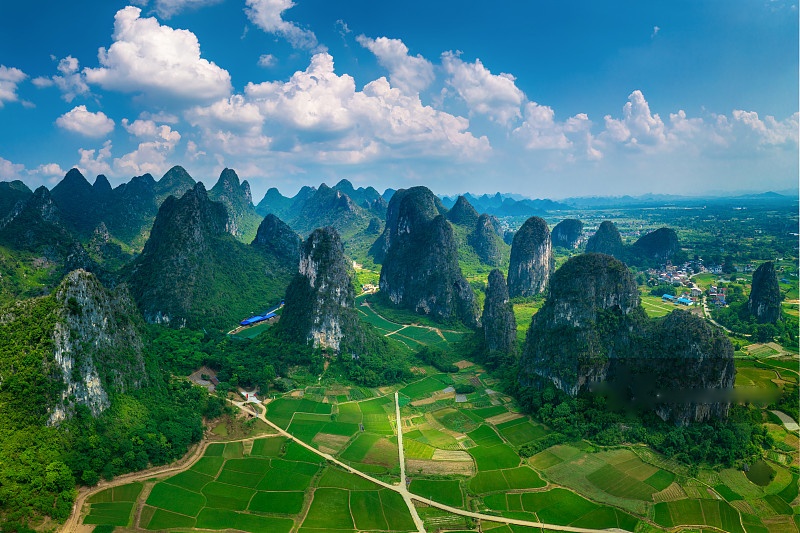
Guilin is a city in northeast Guangxi, and the region is known for its karst peak forest, hills of limestone that stand sharply out of flat farmland along the Li River. A well-known Chinese saying, “Guilin’s scenery is the best under heaven”, sums up its reputation. Most visitors combine a Li River cruise or walk with the old town, Elephant Trunk Hill and the Longji Rice Terraces, and often continue to Yangshuo.
| Li River | 164 km long, from Lingqu mouth in Xing’an to Sanjiang mouth in Pingle |
|---|---|
| Karst age | carbonate rock formed about 320 to 400 million years ago, over 3,000 m thick; limestone porosity under 1% |
| Lingqu Canal | dug in 214 BC to join the Xiang and Li river systems |
| Elephant Trunk Hill | city emblem at the meeting of the Li and Peach Blossom rivers; part of a 5A-rated area since 2017 |
| Longji Rice Terraces | over 650 years old; up to 1,100 m elevation and slopes up to 50 degrees |
| On the banknote | the back of the fifth-series 20 yuan note shows the Li River at Yellow Cloth Shoal |
The Li River and the karst
The Li River’s hills, water and caves are called the three wonders, and geologists call the landform karst peak forest. Rain absorbs carbon dioxide and becomes weakly acidic, and over millions of years it dissolved the limestone into peaks, isolated hills and caves. The rock around Guilin and Yangshuo formed some 320 to 400 million years ago. The climate is subtropical monsoon, hot and wet, and the rainy season coincides with the hottest weather, which is why mornings often bring mist. The river is clear, with a pebble bed and little silt.
In the city
Elephant Trunk Hill looks like an elephant drinking at the water’s edge, and a pagoda called Puxian stands on top. Water Moon Cave, with a stream running through it, lies at its base. Local legend says the elephant belonged to the Jade Emperor and turned to stone when it refused to leave Guilin. The hill is the city’s emblem. Near Duxiu Peak, the Ming dynasty built the Jingjiang Prince’s Mansion in 1370. The Lingqu Canal, dug in 214 BC, joins the Xiang and Li river systems.
Longji Rice Terraces
Longji, “Dragon’s Backbone”, is in Longsheng County north of Guilin. The terraces are more than 650 years old and climb to about 1,100 meters, with slopes of up to 50 degrees. They split into two main viewing areas: Dazhai, also called Jinkeng, which is a Yao village, and Ping’an, a Zhuang village. Chinese Wikipedia reports that local homestays earned about 150 million yuan in 2016 across 354 guesthouses, a sign of how popular the area is, so book rooms early in the growing and harvest seasons. See also our Longji page and Yangshuo page.
When to go and how long
Allow two to three days: one for the Li River and the city, one for Longji, and one for the countryside around Yangshuo. Mist and rain are common, and summer is hot and wet. Spring and autumn are usually the easiest months for walking.
Planning Guilin with Absolute Asia Tours
Absolute Asia Tours has planned private trips in Asia since 1989. For Guilin that means a river cruise or bamboo raft timed to avoid the busiest boats, a driver for Longji, and a guide who knows the villages. We’re rated 4.8 out of 5 across about 900 traveler reviews. See our China tours or tell us your dates.
Sources (read in Chinese, Chinese Wikipedia): 桂林市, 漓江, 象鼻山, 龙脊梯田. Last checked November 2026.
Guilin: FAQ
How long is the Li River?
164 kilometers, from Lingqu mouth in Xing’an to Sanjiang mouth in Pingle.
How old are the Guilin karst hills?
The carbonate rock around Guilin and Yangshuo formed about 320 to 400 million years ago.
What is Elephant Trunk Hill?
A hill shaped like an elephant drinking from the river, and the emblem of Guilin.
How high are the Longji Rice Terraces?
Up to about 1,100 meters, with slopes of up to 50 degrees.
How many days do you need in Guilin?
Two to three days covers the Li River, Longji and the Yangshuo countryside.