Dali sits on a plain between the Cangshan mountains and Erhai Lake in western Yunnan, and it was the center of two kingdoms, Nanzhao and Dali, for about five hundred years. Today it is the capital of the Dali Bai Autonomous Prefecture, where the Bai people make up about 32% of residents and Han Chinese about half. Visitors come for the walled old town, the Three Pagodas, the lake and the slow pace.
| Prefecture | 28,302 km²; average elevation 2,090 m; about 3.34 million residents; Bai about 32% |
|---|---|
| Old kingdoms | Nanzhao founded 738 by Piluoge; the Dali Kingdom from 937 until the Mongol conquest |
| Dali Old Town | Ming-era walled town begun after 1381; wall once 7,248 m around; national historic city since 1982 |
| Three Pagodas | Chongsheng Temple; national protected site since 1961; 5A-rated area |
| Erhai Lake | about 250 km²; up to about 21 m deep; about 42.6 km long and 9 km wide |
The old town
The present old town was built by the Ming after their army took Yunnan in 1381, east of the earlier royal city of Yangjumie, which had served the Nanzhao and Dali kingdoms for nearly five centuries. The Ming wall ran about 7.2 kilometers with four gates and corner towers. Only about 300 meters of it remains, and the south and north gates were rebuilt in 1984, the west gate in 2001 and the east gate in 2002. The main north–south road, Fuxing Road, runs between the gates and passes the Dali Municipal Museum, which occupies the former headquarters of the rebel leader Du Wenxiu, the Wuhua Tower and the Confucian temple. Foreigner Street in the northwest is the busiest tourist strip. For quieter walks, try the side lanes.
The Three Pagodas of Chongsheng Temple
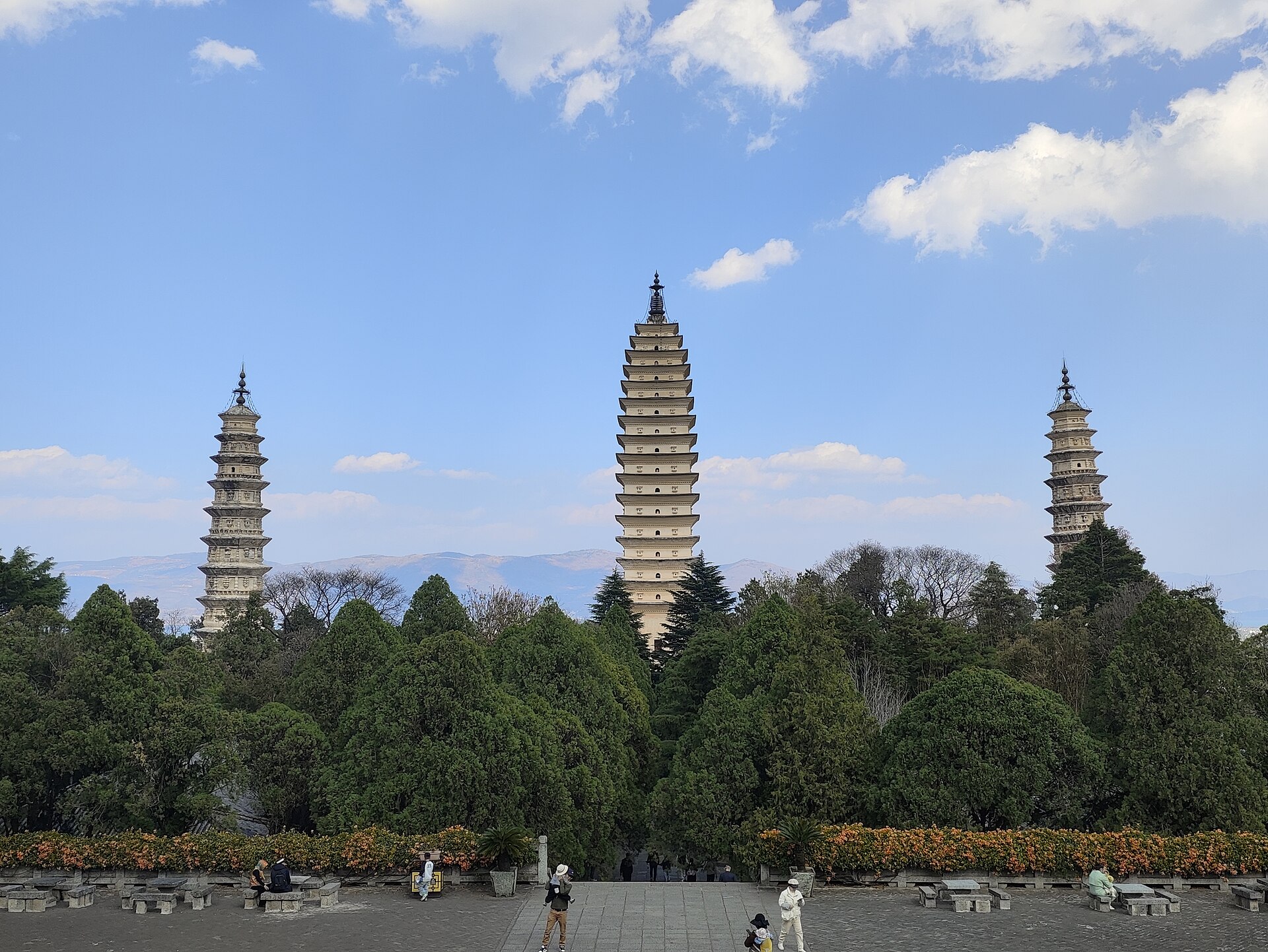
The Three Pagodas stand northwest of the old town below the Cangshan peaks. The tallest, the Qianxun Pagoda, is flanked by two smaller towers set in a triangle. Sources disagree on when the main pagoda was built; dates of 633, 714 and 836 are all proposed, but an inscription dated 889 was found in the pagoda wall in 1984. The pagodas were damaged by earthquakes, repaired in 1550 to 1553, lost the top of the main pagoda in a quake in 1925, and were fully restored from 1978 to 1981. The temple itself no longer exists. They became a national protected site in 1961.
Erhai Lake
Erhai is Yunnan’s second-largest freshwater lake and one of the largest in China. Chinese Wikipedia gives it a surface of about 250 square kilometers, a maximum depth of about 21 meters and a length of 42.6 kilometers from north to south, with 117 streams feeding it, 18 of them from the Cangshan mountains. The waves are small and the shore is flat, which makes it good for cycling the lakeside. Its only outlet is the Xi’er River near Xiaguan.
How long to stay
Dali pairs well with Lijiang and Kunming; most itineraries give it one or two nights. Spend one day on the old town and the Three Pagodas, and another on the lake and Xizhou. At about 2,000 meters elevation, nights can be cool even in spring.
Planning Dali with Absolute Asia Tours
Absolute Asia Tours has planned private trips in Asia since 1989. For Dali that means a guest house in the old town or by the lake, a driver for the lakeside villages and a guide who can explain Bai culture. We’re rated 4.8 out of 5 across about 900 traveler reviews. See our China tours or tell us your dates.
Sources (read in Chinese, Chinese Wikipedia): 大理白族自治州, 崇圣寺三塔, 洱海, 大理古城. Last checked November 2026.
Dali: FAQ
What is Dali known for?
A Ming-era walled old town, the Three Pagodas, Erhai Lake and the Bai culture, on the site of the old Nanzhao and Dali kingdoms.
How big is Erhai Lake?
About 250 square kilometers, up to about 21 meters deep and 42.6 kilometers long.
When were the Three Pagodas built?
Sources disagree. Dates of 633, 714 and 836 are proposed for the main pagoda, and an inscription from 889 was found in it in 1984.
How many days do you need in Dali?
One or two nights is usual, with a day for the old town and pagodas and another for the lake.
Who are the Bai people?
An ethnic group that makes up about 32% of the prefecture’s population.
Photo: Ngguls, Wikimedia Commons, CC BY-SA 4.0. The Three Pagodas of Chongsheng Temple.
