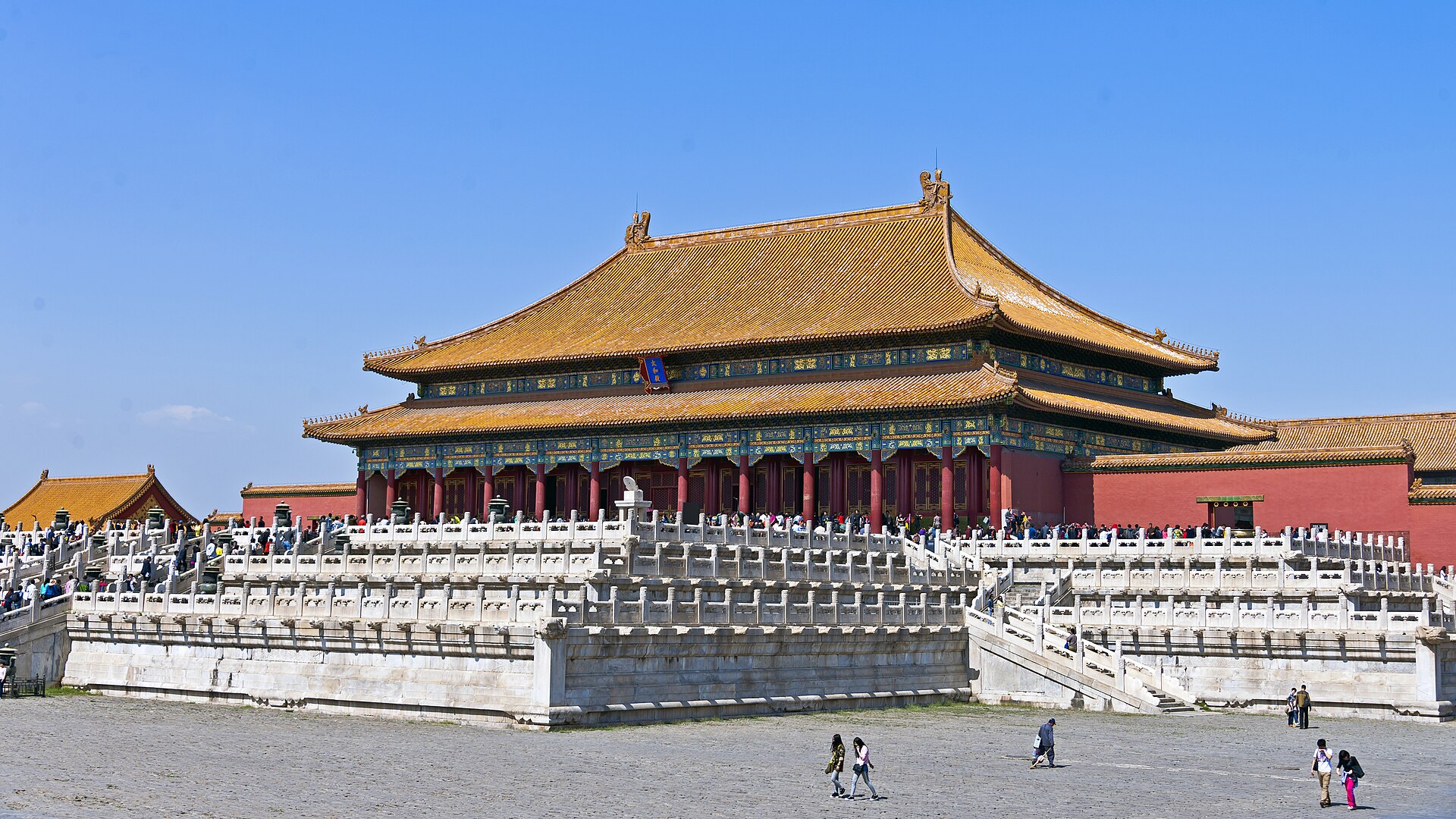
Beijing has been the capital of China for most of the last 600 years, and the city is laid out around that history: palaces, altars and gardens built for the emperors of the Ming and Qing dynasties sit within the city, and the Great Wall runs through the mountains an hour or two to the north. Most of the sights below are UNESCO World Heritage Sites, and the capital’s central axis was added to the list in 2024.
| Forbidden City | built 1406 to 1420, 720,000 m² |
|---|---|
| 1973 survey | about 980 buildings, 8,704 bays (not 9,999 rooms) |
| Central Axis | UNESCO, 27 July 2024 |
| Temple of Heaven | begun 1420, about 2.73 km² |
| Summer Palace | 297 ha, UNESCO 1998 |
| Badaling | 3,741 m of wall open to walk |
The Forbidden City
The Forbidden City was begun in 1406 and completed in 1420, and it served 24 emperors of the Ming and Qing dynasties. It covers 720,000 square meters, and it’s the largest and most complete palace complex still standing. UNESCO listed it in 1987.
Popular lore says it has 9,999 and a half rooms. A survey in 1973 found about 980 buildings with a total of 8,704 jian, where a jian is not a room but the space between four pillars. Either way, it’s too big to cover quickly, so pick the main axis (the three great halls and the inner court) and one side garden, and keep the rest for a second visit. The palace is also the Palace Museum, whose collection is drawn from the Ming and Qing courts.
The Central Axis
The Forbidden City is the center of a north-south axis that organizes the old city. On 27 July 2024 UNESCO inscribed “Beijing Central Axis: A Building Ensemble Exhibiting the Ideal Order of the Chinese Capital” as a World Heritage Site, with the Forbidden City and the Temple of Heaven among its parts. Walking part of it gives you a better sense of how the city was planned.
Temple of Heaven
The Temple of Heaven was where the emperors made sacrifices to heaven and prayed for good harvests. It was begun in 1420 and covers about 2.7 square kilometers, four times the area of the Forbidden City, which makes it the largest surviving ritual complex in China. UNESCO listed it in 1998. The Hall of Prayer for Good Harvests, its best-known building, was destroyed by lightning in 1889 and rebuilt the next year. Go early, when locals use the park for exercise, music and games.
Summer Palace
The Summer Palace is an imperial garden of about 297 hectares in the northwest of the city, built around Longevity Hill and Kunming Lake. Work began in 1750 as the Qingyi Garden, and it was rebuilt in the late Qing period under the Guangxu emperor. UNESCO listed it in December 1998 as a high point of Chinese garden design. Allow half a day, and walk the lakeshore as well as the hill.
The Great Wall at Badaling
Badaling, about 1,015 meters at its highest point, is the best known section of the Great Wall near Beijing. It was the first part opened to the public and is one of the best-preserved stretches of the Ming wall, built around 1504. About 3.7 kilometers of the wall can be walked. It’s also the busiest section, so many travelers choose a quieter stretch for their walk. A guide can match the section to your fitness and the season.
Hutongs
The hutongs are the narrow lanes of old Beijing, lined with courtyard houses. They’re regarded as symbols of the city’s everyday culture, although many have been cleared in redevelopment, so the surviving ones repay a slow walk, preferably with someone who can explain what you’re looking at.
When to go and how long to stay
Spring and autumn are the most comfortable seasons. Allow at least three days: one for the Forbidden City and the axis, one for the Temple of Heaven and Summer Palace, and one for the Great Wall. See our guides to Shanghai, Xi’an and Chengdu for the rest of a classic China route, and our China tours.
Planning Beijing with Absolute Asia Tours
Absolute Asia Tours has planned private trips in Asia since 1989. In Beijing that means a private guide at the Forbidden City who can make sense of the layout, a driver to manage the distances, and a Great Wall section chosen for the day and your pace. We’re rated 4.8 out of 5 across about 900 traveler reviews. Tell us your dates and we’ll plan from there.
Sources (read in Chinese, Chinese Wikipedia): 北京市, 故宫, 天坛, 颐和园, 八达岭. Last checked November 2026.
Things to do in Beijing: FAQ
How many days do you need in Beijing?
At least three: the Forbidden City, the Temple of Heaven and Summer Palace, and the Great Wall.
How many rooms does the Forbidden City have?
Legend says 9,999 and a half, but a 1973 survey counted about 980 buildings and 8,704 bays, or jian.
What is the Beijing Central Axis?
A north-south line that organizes the old city, listed by UNESCO on 27 July 2024.
Which part of the Great Wall is best from Beijing?
Badaling is the best known and easiest, but it’s crowded. A guide can suggest a quieter section.
When was the Temple of Heaven built?
It was begun in 1420. The Hall of Prayer for Good Harvests was rebuilt in 1890 after a lightning fire.
What is the best time to visit Beijing?
Spring and autumn.
Photo: Daniel Case, Wikimedia Commons, CC BY-SA 3.0.
